


 |
|
|
||
|
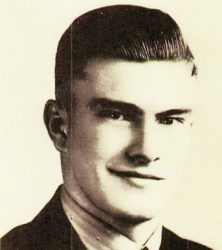
CLARENCE JOHANAS NORBY, Jr. 'John' |
||||
|
Engagements: • World War II (1941 - 1945) |
||||
| Biography: | ||||
|
Clarence Johanas Norby and Flora E Reynolds were married on 09 Jan 1921 in Denver, Adams, CO. They were the parents of only one child; Clarence Johanas "John" Norby Jr. John attended Golden High School in Golden, CO where he played football and ran track. He graduated in 1939. After obtaining his father's permission, Clarence J Norby Jr enlisted as an Apprentice Seaman (A.S.) in the US Navy (NSN:372-19-10) on 09 Oct 1940 in Denver, CO for a period of four years. He was sent to 9 weeks of recruit training at the Naval Training Station (NTS) San Diego. On 29 Nov 1940, AS Norby reported to the Naval Air Station (NAS), San Diego for duty under instruction at the Aviation Machinists Mate Class A School. On 9 Feb 1941, Norby advanced in rate to Seaman Second Class (S2/c). After he completed the trade school, S2/c Norby transferred on 05 April 1941 from NAS San Diego to Commander, Patrol Wing Two (COMPATWING 2) in Pearl Harbor for assignment. He was temporarily sent to the Receiving Station (RS) in San Diego to await his ride to Hawaii. On 28 April 1941, Norby reported as a passenger on board the ex USS Thorton (DD-270) and now seaplane tender, destroyer USS Thorton (AVD-11) in San Diego for transportation to Pearl Harbor. On 17 Jun 1941, S2/c Norby was transferred from the USS Thorton (AVD-11) to Patrol Squadron Twenty-One (VP-21) at Ford Island, Pearl Harbor for duty. Norby advanced in rate to Seaman First Class (S1/c) on 01 July 1941. Norby advanced in rate from S1/c to Aviation Machinist Mate third class (AMM3) on 01 Nov 1941. On 29 Nov 1941, AMM3 Norby reported on board the transport USS William Ward Burrows (AP-6) as a passenger for transport with other members of VP-21 to Wake Island. VP-21 was assigned to Wake Island as a war-time deployment. In mid-November the squadron departed Ford Island, Hawaii for "fleet exercises," and flew toward Wake with Midway as a lay-over point. VP-21 maintenance and support personnel on board the William Ward Burrows probably disembarked at Midway as well. While enroute to Midway the squadron flew Anti-submarine (ASW) patrols for the aircraft carriers USS Enterprise (CV-6) and USS Lexington (CV-2) that were ferrying US Marine fighters and dive-bombers to Wake and Midway. On 07 Dec 1941, VP-21 was still based at Midway. On 08 Dec, two Japanese destroyers shelled Midway's airfield. One Catalina PBY was destroyed but many others were saved by the heroic actions under fire by Ensign John M. Eaton, Jr., who was later awarded the Navy Cross for his actions. The squadron returned to Ford Island on 13 Dec. On 20 Dec 1941, AMM3 Norby disembarked from the USS William Ward Burrows (AP-6) and reported to the Receiving Station, Pearl Harbor. On 02 March 1942, VP-21 began receiving replacement aircraft including the new PBY-5 seaplanes. On 12 Mar 1942, Petty Officer Norby was assigned temporary duty at the PW-1 gunnery school. He completed his gunnery school training and returned to NAS Pearl Harbor on 31 Mar 1942, whereupon he was transferred to Patrol Squadron Forty-Four (VP-44) the same day. Patrol Squadron Forty-four (VP-44) departed from the Naval Air Station, Alameda, CA for Pearl Harbor, T.H., in two divisions of six planes each. The first of these left the United States on March 26, 1942. The second, because of unfavorable weather, delayed its departure until April 12. The rest of the squadron left soon after on board the S.S. Lurline and arrived in Hawaii about five days later. Ordered to Midway for extended operations, PATRON 44 arrived at Eastern Island on the 22nd of May and began long range reconnaissance flights on 27 May in anticipation of a Japanese attempt to capture Midway Island. During the first few days of June 1942, the VP-23 and VP-44 PBYs based at Midway flew long patrols over the trackless ocean, searching for signs of enemy shipping. Then on 3 Jun came the first surface contact reports from the VP-23 PBY searchers. The following day, 04 Jun 1942, pilot Lt. (j.g.) Robert S. Whitman and his PBY-5A Catalina from VP-44 were airborne again when he reported contact at 0925 with enemy ships (probably the Japanese Occupation Force), antiaircraft fire, and that his aircraft was being "opposed by two enemy observation planes." Whitman apparently saw just two but reports indicate there were three. Japanese Mitsubishi F1M2 Type 0 float planes from the seaplane carrier Chitose had attacked Ltjg Whitman's Catalina about 340 miles west of Midway. During the attack Ltjg Robert S. Whitman (pilot), Ens. Walter H Mosley (co-pilot), ARMC James W. Adams (radioman), RM3 William H. O'Farrell (gunner), and AMM3 Clarence J Norby Jr (gunner) were killed. Ens Jame Hill Camp (observer) was mortally wounded (some sources say that it was he who landed the crippled aircraft on the sea surface.), and the plane set afire. AOM2c Philip L. Fulghum, the PBY’s bow gunner, continued to man his .50-caliber machine gun, and sent one of the attackers away trailing smoke. On his own initiative, with a crash imminent, Fulghum released the plane’s two 500-pound bombs. After the crash, AMM1c Virgil Ruel Marsh (flight engineer), despite the roaring flames, freed a rubber boat from the plane, which AMM2c John C. Weeks (gunner) repaired while in the water. Fulghum then assisted the wounded into the raft. He was awarded the Navy Cross for his heroic conduct during this action. Several days later, June 6, 1942, a VP-23 PBY commanded by Ltjg Norman K. Brady located the five men in the raft. He safely picked them up and returned them to Midway. Ensign Camp died on Midway of his wounds on 07 Jun 1942. He was buried at sea a short distance from Midway with military honors. After the battle of Midway Patrol Squadron 44 returned to Pearl Harbor on 09 Jun 1942. Petty Officer Norby was declared missing in action on 04 Jun 1942 and declared presumed dead the same day. His remains were unrecoverable. Petty Officer Norby was awarded (posthumously) the Purple Heart, The American Defense Service Medal w/Fleet Clasp, The American Campaign Medal w/Fleet Clasp, the Asiatic-Pacific Campaign Medal with one bronze battle star and the WWII Victory Medal. ----------------------------- The family of Clarence J. Norby Jr., received a commemoration from President Roosevelt. It reads: In grateful memory of Clarence J. Norby, Jr., United States Navy, who died in the service of his country at Midway Islands, 4 June 1942. He stands in the unbroken line of patriots who have dared to die that freedom might live, and grow, and increase its blessings. Freedom lives, and through it, he lives – in a way that humbles the undertakings of most men. (signed), Franklin D Roosevelt, President of the United States of America ----------------------- The crew of 44-P-12 (call sign 8V55) Lt.(jg) Robert S. Whitman, (Pilot) (KIA) ACRM James W. Adams, (Radio Operator) (KIA-Drowned after clearing downed aircraft) Ens Jack H Camp (Observer) (Died of Wounds 7 Jun 1942) Philip L. Fulghum, AOM2, (Bombardier/Bow gunner) (WIA - exposure) Virgil R. Marsh, AMM1, (Flight Engineer) (WIA - exposure) Ensign Lee Coleman McCleary (Navigator) (WIA) Ensign Walter H. Mosley, (Co-pilot) (KIA) Norby, Clarence J. Jr. AMM3c (Gunner) (KIA) RM3c William H. O'Farrell, (Gunner)(KIA) Weeks, John C. AMM2c (Gunner) (WIA) ----------------------------- Combat Action Ribbon (CR) note: None of the Navy/Marine flight crews in the Battle of Midway were eligible for or were awarded the Combat Action Ribbon (CR). See Navy and Marine Corps Awards Manual (SECNAVINST M-1650.1 of 16 Aug 2019, Appendix 2C.1.c (3) Amplifying Guidance). It reads in part, “The CR will not be awarded in connection with aerial flight, . . . “ The CR was established in 1969 and made retroactive to 07 Dec 1941. According to the Awards Manual, when deemed appropriate, the award for aerial combat is the Air Medal. --------------------------- [Bio #213 compiled by Gerry Lawton (GML470)] Find A Grave Memorial #56127071 |
||||
| Honoree ID: 98928 | Created by: MHOH | |||
Ribbons
Medals
Badges
Honoree Photos
|  | |
| |
|