


 |
|
|
||
|
DELBERT WAYNE HALSEY 'Pete' |
||||
|
Engagements: • World War II (1941 - 1945) |
||||
| Biography: | ||||
|
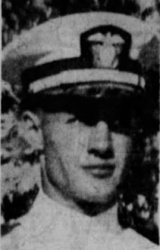
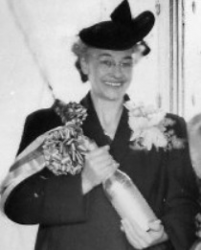
Delbert Wayne Halsey Ensign, United States Naval Reserve Navy Cross, Air Medal & Purple Heart Delbert, or Pete as he was known, was the son of Earl Vondon Halsey and Anna C. Mitchell who married 03 Oct 1913 in Asotin County, WA. His siblings were Wilma Cora and Donald Elvin Halsey. He graduated from Baker High School in June 1938. He entered Montana State University in Missoula that autumn where he was a member of the Beta Delta Chapter of Sigma Chi fraternity. He completed two years of college before applying for the Volunteer Naval Reserve Flight Training Program (V-5). His brother Donald was killed in action in Germany on 19 March 1945. Delbert Wayne Halsey enlisted in Spokane, WA in the US Naval Reserve V-5 aviation program (NSN: 510-01-07) as a Seaman 2c on 9 Dec 1940. He reported to the Naval Reserve Aviation Base (NRAB), Seattle, WA on 16 Dec 1940 for the elimination phase of his flight training the culmination of which must be a short duration solo flight. He successfully completed the elimination phase and was sent home to await further orders. He was ordered to active duty under training on 21 Feb. He reported to NRAB on 26 Feb 1941 and transferred to the Naval Air Station (NAS), Pensacola, FL to accept appointment as a Naval Aviation Cadet and begin flight training. He reported to NAS Pensacola, FL on 06 Mar 1941 (date of rank 01 Mar 1941) whereupon he was discharged at his own request from enlisted status active duty to accept an appointment and take the oath of office as a Naval Aviation Cadet on the following day. He was assigned to Aviation Cadet Class 164-C. He began his primary flight training at NAS Pcola. When he completed that training in late summer 1941 he was transferred the Advance Training Specialized Carrier Group at NAS Miami (NRAB Opa Locka) for about 4 weeks of carrier based aircraft training. While in Miami, he received his designation as a Naval Aviator. Then on 25 Sep 1941 Halsey took the oath of office and accepted the commission as an Ensign, AV-(N). His date of rank was 18 Aug 1941. When that training was complete, Ensign Halsey detached from NAS Miami with orders to report to Bombing Squadron Six for duty. After a short leave period, he transferred to the Advanced Carrier Training Group (ACTG) in San Diego for an additional 4-6 weeks of instruction. He completed training with the ACTG in early December 1941. On 8 Dec 1941, Ensigns Halsey, Arthur Leo Rausch, and Thomas Wesley Ramsay embarked as passengers on board the USS Saratoga (CV-3) for transit from San Diego to Pearl Harbor, HI. Saratoga arrived in Pearl Harbor on 15 Dec 1941 when Ensigns Halsey, Rausch and Ramsay disembarked and reported to the receiving barracks at Pearl Harbor. The next day Enterprise returned to port at Pearl Harbor, and Halsey, Rausch and Ramsay reported to Bombing Squadron Six on 16 Dec 1941 at NAS Pearl Harbor on Ford Island. When Enterprise sailed for training on 03 Jan 1942, Ens. Halsey was on temporary duty with the Senior Naval Aviator at NAS Pearl Harbor on Ford Island along with seven other VB-6 rookie pilots; Ensigns Rausch, Ramsay, Holt, Criswell, Hodson, Grimmell, and Presley. Enterprise returned to port on 07 Jan 1942 and made preparations to get underway again for a long voyage beginning 11 January 1942. The eight rookie pilots returned to their squadron prior to the fly-on later in the day on the 11th. Ens. Halsey received his baptism of fire during the raids on the Marshall Islands on 01 Feb when he flew in the Second Division in aircraft 6-B-18 with AOM2 Arie Turner Alford as his rear seat gunner/radioman. He was awarded the Air Medal for his actions during the raid. Second Division was led by Lt Richard Halsey Best in SBD-3 (6-B-10) and later at the Wake Island attacks on 24 Feb when he flew a borrowed SBD 6-S-18 from Scouting Six with Petty Officer Alford as his rear-seat gunner/radioman. This time he flew in the Third Division led by Lt John D. Blitch in SBD 6-B-4. Halsey's aircraft sustained several bullets through the left wing. On 04 Mar 1942, Halsey was again in the tactical organization of VB-6 during the Marcus Island raids. He flew 6-S-18, the borrowed VS-6 SBD, in the Third Division with Lt Blitch in 6-B-4. Halsey's rear-seat gunner/radioman was ARM2 Parham Screeton Johnson. Enterprise departed the area and arrived at Pearl Harbor on 10 Mar 1942. On 08 April 1942, Enterprise was underway again. Five days later, Enterprise executed a rendezvous with USS Hornet (CV-8) and her deck-full of Army B-25 bombers. Doolittle's raiders took to the cloudy skies on 18 April 1942 delivering a surprise "gift" to Japan. Enterprise and Hornet returned to Hawaii on 25 April 1942. Underway on 30 April, Enterprise and USS Hornet received their squadrons from bases on Hawaii. It was to be a badly needed training cruise, however, several days later Enterprise and Hornet were directed to the South Pacific to assist aircraft carriers USS Lexington (CV-2) and USS Yorktown (CV-5) engaged in the battle of the Coral Sea. The battle was over before they could arrive on-scene. Enterprise was then directed to perform a feint towards Nauru and Banaba (Ocean) islands which caused the Japanese to delay Operation RY to seize the two islands. Enterprise returned to Pearl Harbor on 26 May and began intensive preparations to meet an expected Japanese thrust at Midway Island. She got underway from Pearl Harbor on 28 May 1942, and with USS Hornet (CV-8), steamed toward a point Northeast of Midway called "Point Luck." USS Yorktown (CV-5) followed a short time later. Early on the morning on 4 Jun 1942 aircraft of the USS Enterprise's air group six launched to attack the Japanese carrier striking force that was approaching the Midway atoll. After a long, fruitless search for the enemy fleet, the warplanes of VS-6 and VB-6 (including Ens. Halsey in 6-B-6 with his rear-seat gunner/radioman Jay W. Jenkins in the First Division led by Lt Dick Best in 6-B-1.) that had become separated from the fighters and torpedo planes of Air Group Six were nearing the limits of their fuel. Lcdr McClusky, Commander Enterprise Air Group (CEAG), leading the formation decided to make a starboard turn in a methodical box search toward the northwest in a last desperate bit to find the Japanese carrier force. Another five minutes and McClusky would have to turn to the northeast and home. Fortune smiled several minutes later at 0955. McClusky sighted a Japanese warship steaming at high speed in a direction almost perpendicular to McClusky's course. He decided to follow the ship -- a decision that had historical consequences! At 1002, McClusky and others detected the white wakes of the Japanese Carrier Striking force. Lined up for the attack VB-6 aircraft pushed over into their dive. What was noticeably absent were Japanese fighters. Now half way through their dive, VB-6 began to see bursts of anti-aircraft fire from below. In their sights was Kaga. A number of near-misses and a number of direct hits on Kaga turned her into an inferno from stem to stern. Lt Best in 6-B-1 and several planes of his First Division (Ltjg Edwin J. Kroeger in 6-B-2 and Ens. Frederick T. Weber in 6-B-3) changed their target and set their sights on Akagi. They dove nearly straight down. Best made a direct hit while his two partners had near misses. One of the near-misses with a thousand pound bomb disable Akagi's rudder. Best's thousand pounder was the only hit on Akagi -- the results were fatal however. After pull out, VB-6 beat a hasty retreat threading their way through a gauntlet of swarming enemy fighters and a hail of anti-aircraft fire. Of the fifteen dive bombers from VB-6 that took off from the Enterprise that morning only eight survived the attack. Enemy anti-aircraft fire and fuel exhaustion took the biggest toll on this squadron after their initial attacks. Pilot Ens Delbert Wayne Halsey and his rear-seat gunner, RM3 Jay William Jenkins, were last seen making a picture perfect powerless water landing then climbing into their rubber raft. They were never seen again. Halsey and Jenkins were listed as missing in action on 04 Jun 1942. Delbert's parents received a telegraph from the Navy Department on 18 June 1942 informing them that Ensign Halsey was missing in the service to his country (It did not say he was missing in action.). Halsey's remains were unrecoverable. He was presumed dead on 05 Jun 1943. Ensign Halsey was awarded the Navy Cross, (The award was issued prior to his being declared presumed death so it wasn't awarded posthumously.), Purple Heart, the Presidential Unit Citation w/ribbon, American Defense Service Medal, Asiatic-Pacific Campaign Medal with four bronze battle stars (Marshall Island raid, Marcus Island raid, Wake Island raid and Midway. Flew in combat in all four battles.) and the World War II Victory Medal. The Air Medal had previously been awarded to him. ------------------------------- Navy Cross citation reads: The President of the United States of America takes pride in presenting the Navy Cross to Delbert Wayne Halsey, Ensign, United States Naval Reserve, for extraordinary heroism in operations against the enemy while serving as Pilot of a carrier-based Navy Dive Bomber in Bombing Squadron SIX, attached to the U.S.S. ENTERPRISE, during the "Air Battle of Midway," against enemy Japanese forces on 4 - 6 June 1942. Defying extreme danger from concentrated anti-aircraft barrage and powerful fighter opposition, Ensign Halsey, with bold determination and courageous zeal, led his squadron in dive-bombing assaults against Japanese naval units. Flying at a distance from his own forces which rendered return unlikely because of probable fuel exhaustion, he pressed home his attacks with extreme disregard for his own personal safety. His gallant intrepidity and loyal devotion to duty contributed greatly to the success of our forces and were in keeping with the highest traditions of the United States Naval Service. General Orders: Bureau of Naval Personnel Information Bulletin No. 309 (December 1942) ------------------------------------ USS Enterprise (CV-6) Presidential Unit Citation reads: For consistently outstanding performance and distinguished achievement during repeated action against enemy Japanese forces in the Pacific war area, 7 December 1941, to 15 November 1942. Participating in nearly every major carrier engagement in the first year of the war, the Enterprise and her air group, exclusive of far-flung destruction of hostile shore installations throughout the battle area, did sink or damage on her own a total of 35 Japanese vessels and shot down a total of 185 Japanese aircraft. Her aggressive spirit and superb combat efficiency are fitting tribute to the officers and men who so gallantly established her as an ahead bulwark in the defense of the American nation. Actions of the Enterprise mentioned in the citation include the Gilbert and Marshalls of 01 Feb 1942; Wake Island raid, 24 Feb 1942; Marcus Island raid, 04 Mar 1942; Battle of Midway, 4-6 Jun 1942; Occupation of Guadalcanal, 7-8 Aug 1942; Battle of Stewart Islands, 24 Aug 1942; Battle of Santa Cruz Islands, 26 Oct 1942; and Battle of Solomon Islands, 14-15 Nov 1942. ---------------------------- His family also received a personal commemoration from President Franklin D. Roosevelt. It reads: In grateful memory of Delbert Wayne Halsey, who died in the service of his country, SEA, Pacific Area, ATTACHED U.S.S. ENTERPRISE, 5 JUNE 1943 (Presumed). He stands in the unbroken line of patriots who have dared to die that freedom might live and grow and increase its blessings. Freedom lives, and through it, he lives -- in a way that humbles the undertakings of most men. (Signed) Franklin D. Roosevelt, President of the United States ----------------------------- Task Force 16 Citation Recognizing its contribution to the Doolittle Raid, 18 April 1942 On the occasion of the 50th anniversary of the Second World War, it is appropriate that we take time to reflect on the unique and daring accomplishments achieved early in the war by Task Force 16. Sailing westward under sealed orders in April 1942, only four months after the devastating raid on Pearl Harbor, Task Force 16, carrying sixteen Army B-25 bombers, proceeded into history. Facing adverse weather and under constant threat of discovery before bombers could be launched to strike the Japanese homeland, the crews of the ships and LTC Doolittle's bombers persevered. On 18 April 1942 at 14:45, perseverance produced success as radio broadcasts from Japan confirmed the success of the raids. These raids were an enormous boost to the morale of the American people in those early and dark days of the war and a harbinger of the future for the Japanese High Command that had so foolishly awakened "The Sleeping Giant." These exploits, which so inspired the service men and women and the nation live on today and are remembered when the necessity of success against all odds is required. (Signed) John H.Dalton Secretary of the Navy 15 May 1995 --------------------------------- The USS Delbert W. Halsey (DE-310) , a Evarts class destroyer escort was named in his honor. It was launched on 11 April 1944 at the Mare Island Navy Yard, Vallejo, CA, sponsored by his mother, Mrs Anna Halsey, but was never completed. Construction was cancelled on 5 Sep 1944. -------------------------------------- Combat Action Ribbon (CR) note: Navy/Marine flight crews in aerial combat are not eligible for or were awarded the Combat Action Ribbon (CR). See Navy and Marine Corps Awards Manual (SECNAVINST M-1650.1 of 16 Aug 2019, Appendix 2C.1.c (3) Amplifying Guidance). It reads in part, “The CR will not be awarded in connection with aerial flight, . . . “ The CR was established in 1969 and made retroactive to 07 Dec 1941. According to the Awards Manual, when deemed appropriate, the award for aerial combat is the Air Medal. [Bio #190 compiled by Gerry Lawton (GML470)] Find A Grave Memorial #180372128 |
||||
| Honoree ID: 93473 | Created by: MHOH | |||
Ribbons
Medals
Badges
Honoree Photos
|  |  |
 |  |
|