


 |
|
|
||
|
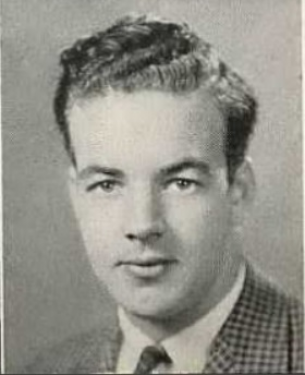
HAROLD JOHN ELLISON 'Hal' |
||||
|
Engagements: • World War II (1941 - 1945) |
||||
| Biography: | ||||
|
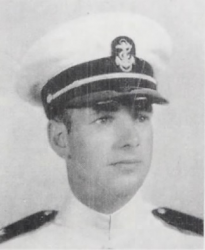
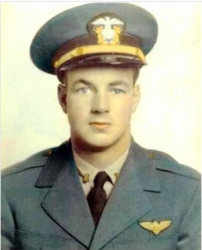
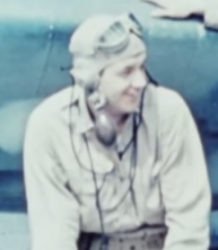
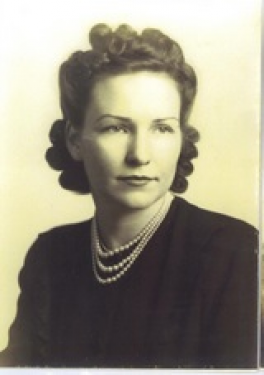
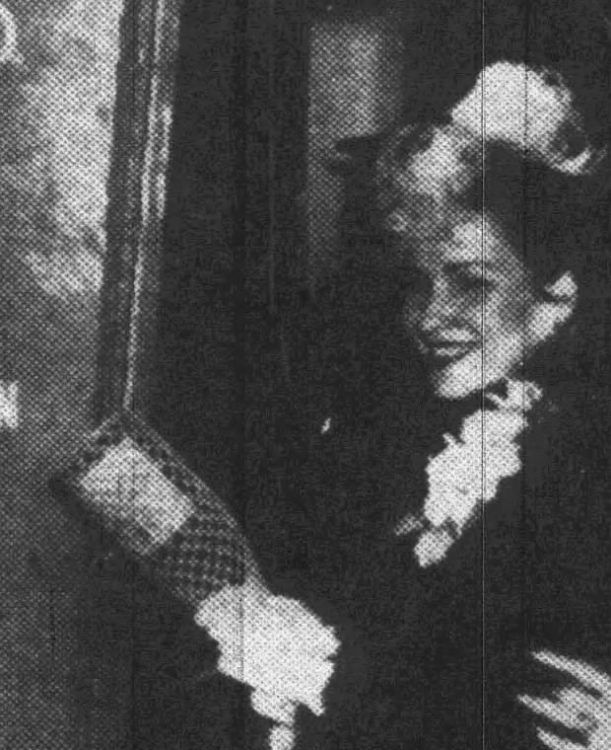
Harold John Ellison Ensign, United States Naval Reserve Navy Cross HAROLD JOHN ELLISON was born on 17 Jan 1917 in Buffalo, Erie, NY. He was also known sometimes as Hal or Elly Ellison. He was the son of William Cuthbert Ellison and Mae E Little who married on 6 Jan 1916 in Buffalo, NY. Harold had one sibling, Frank E. Ellison who was also a WWII navy veteran. Elly graduated from the Buffalo Technical High School in Jun 1936 then later attended the Pratt Institute of Fine and Applied Arts, Brooklyn, NY where he graduated in June 1939. Upon returning to Buffalo, NY., Harold was employed as a commercial designer in the printing industry. On 15 Feb 1940, Harold registered for the World War II draft. In Feb of 1941, Harold was notified that he was being called to service. Unfortunately, he neglected to let the local draft board know that he was about to enlist in the US Naval Reserve Flight program. After some discussions with the draft board, Ellison was required to take the physical to prove that he had reported as called. He was "rejected" in order to allow him to enlist in the navy. Elly enlisted as a Seaman 2/c in the V-5 Naval Reserve Aviation Cadet (AvCad) Program (NSN: 403 88 83) on 4 March 1941 at the Third Naval District in Brooklyn, NY. He reported the same day to the Naval Reserve Aviation Base (NRAB), Floyd Bennett Field, Brooklyn where he completed the Naval elimination flight training on 31 March 1941. On the same day, he received orders to the Naval Air Station (NAS), Pensacola, FL to continue his training under instruction.S2/c Ellison reported to NAS Pensacola on 3 April 1941 where he accepted an appointment as an Aviation Cadet. He began flight training with Aviation Cadet Class 4A-41-P (C) under instruction at the NAS, Pensacola followed by advanced flight training at NAS, Miami, and was designated a naval aviator, 3 Sep 1941. He detached from Miami on the same date with orders to the Advanced Carrier Training Group, Atlantic Fleet, NAS Norfolk, VA, for temporary duty, and subsequently was assigned to Torpedo Squadron Eight (VT-8) attached to the recently commissioned aircraft carrier USS Hornet (CV-8). After several months of shakedown training in the Atlantic and Caribbean, the Hornet with her air group embarked was certified battle ready. She departed Norfolk, VA for the Pacific via the Panama Canal and steamed to San Diego in March 1942. The following month, she played a major role in the successful attack on Japan by Col Doolittle's Army Air Force bombers on 18 April 1942. In early May, the Hornet and USS Enterprise (CV-6) were dispatched to the South Pacific to assist the carriers USS Lexington (CV-2) and USS Yorktown (CV-5) during the battle of the Coral Sea. Unfortunately, the battle was over before the Hornet and Enterprise could reach the Coral Sea. In late May 1942, a large Japanese carrier striking force was steaming from Japan toward the Midway Atoll with the intent of conquest. The Hornet, along with carriers Yorktown and Enterprise steamed from Pearl Harbor on 28 May 1942 to intercept and destroy the Japanese Striking Fleet. Early on the morning of 4 Jun 1942, Hornet’s air group comprised of 59 strike aircraft including VT-8, launched from her flight deck. Led by the air group leader, Cdr Stanhope Ring, Hornet’s strike package flew in a direction that would lead them on the infamous “Flight to Nowhere” as it became known because the only squadron to engage the enemy on 04 Jun from the Hornet was VT-8. Lcdr John Waldron, skipper of VT-8 , knew the correct course to fly to the enemy, and he led his squadron away from his air group. The 15 TBD-1 Devastator aircraft of VT-8 found the Japanese carriers and immediately assumed an attack profile without friendly fighter support. The Japanese quickly spotted the incoming threat. Overwhelmed by superior numbers of Japanese Combat Air Patrol (CAP) fighters and a steel curtain of anti-aircraft fire, the 15 planes of VT-8, without any covering fighter protection of their own, were quickly shot down one by one with the loss of 29 of the 30 air crew. According to the Hornet’s Midway battle after action report dated 13 Jun 1942, Ens. Ellison and his gunner/radioman ARM3 George Field were listed as "missing in action” on 4 Jun 1942. On 5 Jun 1943, they were officially declared presumed dead. Their remains were unrecoverable. In that report Rear Admiral (Select) Mitscher, Hornet CO, nominated each member of Torpedo Eight who flew into battle on 4 Jun 1942 for the Congressional Medal of Honor. Ensign Ellison was awarded (posthumously) the Navy Cross, Purple Heart, Presidential Unit Citation ribbon, American Defense Service Medal, Asiatic-Pacific Campaign Medal with one bronze Battle Star, and the World War II Victory Medal. -------------------------------- The Navy Cross Citation reads: The President of the United States takes pleasure in presenting the Navy Cross (Posthumously) to Harold J. Ellison, Ensign, U.S. Naval Reserve, for extraordinary heroism in operations against the enemy while serving as Pilot of a carrier-based Navy Torpedo Plane of Torpedo Squadron EIGHT (VT-8), embarked from the U.S.S. HORNET (CV-8), during the "Air Battle of Midway," against enemy Japanese forces on 4 June 1942. Grimly aware of the hazardous consequences of flying without fighter protection, and with insufficient fuel to return to his carrier, Ensign Ellison resolutely, and with no thought of his own life, delivered an effective torpedo attack against violent assaults of enemy Japanese aircraft fire. His courageous action, carried out with a gallant spirit of self-sacrifice and a conscientious devotion to the fulfillment of his mission, was a determining factor in the defeat of the enemy forces and was in keeping with the highest traditions of the United States Naval Service. ---------------------------------- The Presidential Unit citation (PUC) reads: For extremely heroic and courageous performance in combat during the Air Battle of Midway, June 4, 1942. Flying low without fighter support, Torpedo Squadron EIGHT began the perilous mission, Intercept and attack! First to sight the enemy, the squadron attacked with full striking power against crushing enemy opposition, scoring torpedo his on Japanese forces. Realizing to a man that insufficient fuel would prevent a return to the carrier, the pilots held doggedly to the target, dropping torpedoes at point-blank range in the face of blasting antiaircraft fire that sent the planes one by one, hurtling aflame in the sea. The loss of 29 lives, typifying valor, loyalty, and determination, was the price paid for Torpedo Squadron EIGHTs vital contribution to the eventual success of our forces in this epic battle of the air. --------------------------------- The US Navy destroyer escort USS Harold J Ellison (DE-545) was named in honor of him, but was cancelled in 1944 while under construction. The US Navy destroyer of the Gearing Class, USS Harold John Ellison (DD-864), was then named for him and commissioned on 23 Jun 1945 at the New York Navy Yard, Brooklyn [according to US Navy records of the ship]. She served primarily in the Atlantic and Mediterranean until Sept 1965 when she departed Norfolk, VA with Destroyer Squadron 24 enroute to operations in Viet Nam. She completed an around the world cruise back in Norfolk on April 1966. Ellison was decommissioned on 01 Oct 1983 when together with the USS William C. Lawe, which was decommissioned on the same day, were the last Gearing Class destroyers in active serve in the US Navy. Ellison was transferred to Pakistan. The ship was used for parts and then sunk as a target vessel in 1994. ---------------------------------------------- Task Force 16 Citation Recognizing its contribution to the Doolittle Raid, 18 April 1942 On the occasion of the 50th anniversary of the Second World War, it is appropriate that we take time to reflect on the unique and daring accomplishments achieved early in the war by Task Force 16. Sailing westward under sealed orders in April 1942, only four months after the devastating raid on Pearl Harbor, Task Force 16, carrying sixteen Army B-25 bombers, proceeded into history. Facing adverse weather and under constant threat of discovery before bombers could be launched to strike the Japanese homeland, the crews of the ships and LTC Doolittle's bombers persevered. On 18 April 1942 at 14:45, perseverance produced success as radio broadcasts from Japan confirmed the success of the raids. These raids were an enormous boost to the morale of the American people in those early and dark days of the war and a harbinger of the future for the Japanese High Command that had so foolishly awakened "The Sleeping Giant." These exploits, which so inspired the service men and women and the nation live on today and are remembered when the necessity of success against all odds is required. (Signed) John H.Dalton Secretary of the Navy 15 May 1995 -------------------------- His family also received a commemoration in honor of Harold from President Franklin D. Roosevelt. It reads: In grateful memory of Harold John Ellison, who died in the service of his country at SEA, Pacific Area, ATTACHED U.S.S. HORNET, 5 JUNE 1943 (Presumed). He stands in the unbroken line of patriots who have dared to die that freedom might live and grow and increase its blessings. Freedom lives, and through it, he lives -- in a way that humbles the undertakings of most men. (Signed) Franklin D. Roosevelt, President of the United States of America ----------------------------------------- Combat Action Ribbon (CR) note: Navy/Marine flight crews in the Battle of Midway (or any combat) were not eligible for or were awarded the Combat Action Ribbon (CR). See Navy and Marine Corps Awards Manual (SECNAVINST M-1650.1 of 16 Aug 2019, Appendix 2C.1.c (3) Amplifying Guidance). It reads in part, “The CR will not be awarded in connection with aerial flight, . . . “ The CR was established in 1969 and made retroactive to 07 Dec 1941. According to the Awards Manual, when deemed appropriate, the award for aerial combat was/is the Air Medal. -------------------------------------- Harold married Audrey Faye Dannelly on 30 Dec 1941 in Norfolk, VA. The couple had no children. Audrey, born in Canoe, Escambia, Alabama on 24 Jan 1917 only one week after her future husband was born in Buffalo, NY on 17 Jan 1917. She died on Pearl Harbor Day, 07 Dec 2006 in El Paso, TX. Although married for less than six months before her husband's death at Midway, Audrey never remarried. She was a Gold Star wife. It was said about her in her obituary, "He life held many milestones but that was not what she was about. She lived for the future, high expectations her style. Vitality was her demeanor; her creed Honor, Valor, Loyalty. Most of all she believed in GOD, COUNTRY and PEOPLE. In her lifetime she served as a teacher, spent 18 months with the Red Cross in the Philippines during WWII, a business woman plus an active volunteer in many organizations." She was an ardent supporter of the establishment of the WWII Veterans Memorial. Faye, as she was known, christened the destroyer USS Harold J. Ellison (DD-864) named after her husband on 14 Mar 1945 and participated in its decommissioning on 01 Oct 1983. The crew continued to honor her throughout the years. She was one of the few remaining original Plank Owners. Her ashes were buried in Whitmire Cemetery, Ferry Pass, Escambia, FL, with her parents and close to where her husband first earned the gold wings of a naval aviator way back in 1941. [Quoted excerpts about Audrey taken from her obituary published in the El Paso Times (El Paso, TX) - 17 Dec 2006, Sun, p. 28] --------------------------------------- [Bio #106 Compiled on 31 Jan 2018 by Gerry Lawton (G47)] Find A Grave Memorial #56129590 Military Hall of Honor #91654 Fold3 listed |
||||
| Honoree ID: 91654 | Created by: MHOH | |||
Ribbons
Medals
Badges
Honoree Photos
|  |  |
 |  |
 |