


 |
|
|
||
|
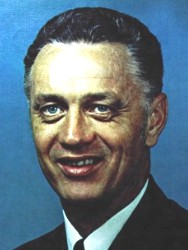
Burton Hale Shepherd |
||||
|
Engagements: • Korean War (1950 - 1953)• Vietnam War (1960 - 1973) |
||||
| Biography: | ||||
|
Burton Hale Shepherd On 4 September 1967, then-Commander Burton Hale Shepherd was serving as a Pilot and as Commander, Attack Carrier Air Wing Sixteen (CVW-16), embarked in U.S.S. Oriskany (CVA-34), near the Republic of Vietnam. On that date, CDR Shepherd was the strike leader of a 20-plane major air wing strike executing his plan of attack against the Haiphong Highway Bridge South-Southeast in North Vietnam, a vital link in the enemy's lines of communications to the south. Exploiting known enemy weaknesses, CDR Shepherd effectively deployed his support forces in a feint, which initially split and deceived the enemy's defenses. In spite of diluting the enemy defenses, it was necessary for CDR Shepherd to maneuver the strike group through repeated surface-to-air missile attacks. Encountering intense anti-aircraft fire as he approached, CDR Shepherd directed the flak suppression elements into coordinated attacks against those sites posing the major threat, then positioned the strike group for optimum attack. Disregarding the enemy's lethal barrage of anti-aircraft fire, CDR Shepherd placed his bombs directly on target. Following his example, the strike force bombed with equal precision, destroying 4 of the 5 bridge spans while minimizing collateral damage to the surrounding civilian area. Completing his attack, CDR Shepherd remained over the target to ensure that all aircraft cleared the high threat area safely. As a direct result of CDR Shepherd's faultless execution of his strike plan, this vital and heavily-defended link in the enemy's logistic network was destroyed without loss to the strike force. CDR Shepherd's courageous leadership and exceptional skill led directly to the irrefutable success of the mission and earned him the U.S. Navy's third highest award for valor, the Silver Star Medal. On 24 October 1967, CDR Shepherd planned, briefed and led one of the largest most-significant strikes of the war against the Phuc Yen Airfield located 11 miles north of Hanoi in North Vietnam. CDR Shepherd's strike force was tasked with cratering the runway and taxiways at Phuc Yen. During the final phase of the long, harrowing penetration deep into the enemy's heartland, the strike force encountered intense opposition from surface-to-air missile attacks and accurate anti-aircraft artillery fire. CDR Shepherd brilliantly led his strike force through a series of effective evasive maneuvers against missiles that were tracking members of his flight. The sky over Phuc Yen was blackened with exploding anti-aircraft shells as he led the entire strike group in penetrating this serious threat and executed a precise, controlled attack on the runway and taxiways. CDR Shepherd scored direct hits on the western-third of the runway and the remainder of his strike group created multiple craters in the runway and taxiways that rendered them unserviceable to jet aircraft. CDR Shepherd's meticulous planning and superb leadership that day earned him a Gold Star in lieu of a Second Award of the Silver Star Medal. On 26 October 1967, CDR Shepherd was the strike leader of an 18-plane strike group launched against the strategically located and heavily defended Hanoi thermal power plant in North Vietnam, CDR Shepherd, although hampered by adverse weather conditions en route, maintained the precise timing necessary to properly execute the intricate strike plan. Skillfully maneuvering to avoid the numerous tracking missiles and intense and accurate barrages of 57-mm. and 85-mm. flak, CDR Shepherd led the strike group to the optimum roll-in point and then aggressively pressed home his attack, releasing all bombs on target. As he egressed from the target area in a hail of enemy fire, CDR Shepherd retired to the relative safety of the Karst Hills and checked in his strike group. After proceeding expeditiously to the coast to refuel, CDR Shepherd returned to an area south of the target to search for one of his missing strike pilots. Continuing the search for more than an hour over enemy terrain in the face of the most concentrated enemy fire in North Vietnam, CDR Shepherd finally returned to the coast after reaching a low fuel state. CDR Shepherd's courage, aggressive leadership, and excellent airmanship that day contributed, in large measure, to the destruction of this major target and earned him the U.S. Navy's second highest award for valor, the Navy Cross. Medals and Awards (Partial List) Navy Cross Navy Cross Citation The President of the United States of America takes pleasure in presenting the Navy Cross to Commander Burton Hale Shepherd (NSN: 0-507539), United States Navy, for extraordinary heroism in aerial flight on 26 October 1967 as Commander, Attack Carrier Air Wing SIXTEEN (CVW-16), embarked in U.S.S. ORISKANY (CVA-34). As the strike leader of an eighteen-plane strike group launched against the strategically located and heavily defended Hanoi thermal power plant in North Vietnam, Commander Shepherd, although hampered by adverse weather conditions en route, maintained the precise timing necessary to properly execute the intricate strike plan. Skillfully maneuvering to avoid the numerous tracking missiles and intense and accurate barrages of 57-mm. and 85-mm. flak, he led the strike group to the optimum roll-in point and then aggressively pressed home his attack, releasing all bombs on target. Egressing from the target area in a hail of enemy fire, he retired to the relative safety of the Karst Hills and checked in his strike group. After proceeding expeditiously to the coast to refuel, Commander Shepherd returned to an area south of the target to search for one of his missing strike pilots. Continuing the search for more than an hour over enemy terrain in the face of the most concentrated enemy fire in North Vietnam, he finally returned to the coast after reaching a low fuel state. By his aggressive leadership, professional airmanship, and determination, Commander Shepherd contributed in large measure to the destruction of this major target, and upheld the highest traditions of the United States Naval Service. Silver Star Medal Citation (1st of 2 Awards) The President of the United States of America takes pleasure in presenting the Silver Star to Commander Burton Hale Shepherd (NSN: 0-507539), United States Navy, for conspicuous gallantry and intrepidity in action while serving as the pilot of a jet attack aircraft, attached to the U.S.S. ORISKANY (CVA_34), as Commander Attack Carrier Air Wing SIXTEEN. As strike leader of a twenty plane major air wing strike on 4 September 1967, Commander Shepherd conceived and executed a brilliant plan of attack against the Haiphong Highway Bridge South-Southeast, North Vietnam, a vital link in the enemy's lines of communications to the south. Exploiting known enemy weaknesses, he effectively deployed his support forces in a feint, which initially split and deceived the enemy's defenses. In spite of diluting the enemy defenses, it was necessary for Commander Shepherd to maneuver the strike group through repeated surface-to-air missile attacks. Encountering intense anti-aircraft fire as he approached, he directed the flak suppression elements into coordinated attacks against those sites posing the major threat, then positioned the strike group for optimum attack. Disregarding the enemy's lethal barrage of anti-aircraft fire, Commander Shepherd placed his bombs directly on target. Following his example, the strike force bombed with equal precision, destroying four of the five bridge spans while minimizing collateral damage to the surrounding civilian area. Completing his attack, Commander Shepherd remained over the target to ensure that all aircraft cleared the high threat area safely. As a direct result of Commander Shepherd's faultless execution of his strike plan, this vital and heavily defended link in the enemy's logistic network was destroyed without loss to the strike force. Commander Shepherd's courageous leadership, exceptional skill and devotion to duty led directly to the irrefutable success of the mission and are in keeping with the highest traditions of the United States Naval Service. Silver Star Medal Citation (2nd of 2 Awards) The President of the United States of America takes pleasure in presenting a Gold Star in lieu of a Second Award of the Silver Star to Commander Burton Hale Shepherd (NSN: 0-507539), United States Navy, for conspicuous gallantry and intrepidity while participating in aerial flight as a jet attack pilot attached to and commanding Attack Carrier Air Wing SIXTEEN, embarked in U.S.S. ORISKANY (CVA-34), on 24 October 1967. Commander Shepherd planned, briefed and led one of the largest most significant strikes of the war against the Phuc Yen Airfield located 11 miles north of Hanoi. Commander Shepherd's strike force was tasked to crater the runway and taxiways at Phuc Yen. During the final phase of the long harrowing penetration deep into the enemy's heartland, the strike force encountered intense opposition from surface-to-air missile attacks and accurate anti-aircraft artillery fire. Commander Shepherd brilliantly led his strike force through a series of effective evasive maneuvers against missiles that were tracking members of his flight. The sky over Phuc Yen was blackened with exploding anti-aircraft shells as he led the entire strike group in penetrating this serious threat and executed a precise, controlled attack on the runway and taxiways. Commander Shepherd scored direct hits on the western third of the runway and the remainder of his strike group created multiple craters in the runway and taxiways which rendered them unserviceable to jet aircraft. Commander Shepherd's meticulous planning, superb leadership, gallant actions and devotion to duty were in keeping with the highest traditions of the United States Naval Service. |
||||
| Honoree ID: 320633 | Created by: MHOH | |||
Ribbons
Medals
Badges
Honoree Photos
|  | |
| |
|