


 |
|
|
||
|
Robert Thomas Edlin |
||||
|
Engagements: • World War II (1941 - 1945) |
||||
| Biography: | ||||
|
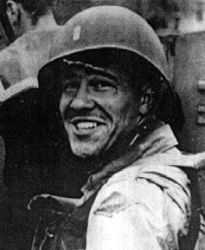
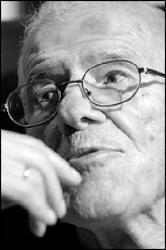
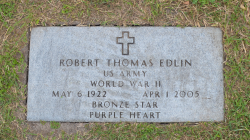
Robert Thomas Edlin At age 17, Robert Thomas Edlin joined the Indiana National Guard at New Albany, IN, and was assigned to the 38th Infantry Division. After the 38th Infantry Division was mobilized and sent to Camp Shelby, MS, Edlin applied to become an officer. Upon completion of Officer Candidate School, he was commissioned as a Second Lieutenant of Infantry and transferred to the Pennsylvania National Guard's 28th Infantry Division. When he was unsuccessful in obtaining a transfer from the 28th Infantry, he volunteered for the Rangers as a way to transfer to a different unit. On D-Day, 6 June 1944, now-First Lieutenant Edlin was a rifle company platoon leader in Company A, 2nd Ranger Battalion. At 0700 hours, 1LT Edlin led his platoon onto Omaha Beach and, after blowing up a section of the sea wall, the Rangers led the way off the beach and fought their way westward to join their comrades at Pointe du Huc. During that action, 1LT Edlin sustained disabling wounds in both legs and was evacuated to England the next day. On 15 July, was able to rejoin his platoon in France. On 10 September 1944, 1LT Edlin and the 2nd Ranger Infantry Battalion were now part of Ninth U.S. Army and in action against German forces during a dawn attack on the Graf Spee, or Lochrist, battery near the French town of Le Conquet. This was a coastal artillery battery with four 280 mm guns, 3 of which could be traversed towards the American forces surrounding Brest. Their 28 kilometer range made them very dangerous. Although the German garrison had been subjected to intense fire the previous days, getting them to surrender was still a very hazardous task. 1LT Edlin decided to lead a 4-man reconnaissance patrol to spot enemy pillboxes and snipers and chart a way through the minefield surrounding the garrison. Capturing the garrison was critical in the effort to retake the port city. The patrol navigated the large minefield and encountered a German pillbox, where 1LT Edlin captured the officer in charge. 1LT Edlin then forced the officer to escort him and his interpreter to the commanding officer of the Graf Spee battery. Upon arrival at the Commander's office, 1LT Edlin pulled the pin from a hand grenade, held it against the Commander's stomach and told him to surrender, or die. The German capitulated and surrendered his entire battery consisting of four 280-mm guns, supporting small-arms positions and pill boxes, and about 800 troops. By his ingenuity, personal courage and willingness to sacrifice his life, 1LT Edlin brought about the surrender of the most important enemy installation in the sector. 1LT Edlin’s courageous actions and extraordinary heroism that day earned him the U.S. Army's second highest award for valor, the Distinguished Service Cross. * * Lieutenant Colonel James Earl Rudder ('Rudder's Rangers'), commander of the 2nd Ranger Battalion, recommended 1LT Edlin for the Medal of Honor. However, 1LT Edlin refused to accept the MOH in order to remain with his platoon. [Medal of Honor recipients were required to be reassigned to a unit within the continental United States.] As a result, 1LT Edlin was instead awarded the Distinguished Service Cross. After World War II, Edlin returned to the Indiana National Guard and served from 1948-1954, with the rank of Captain. In 1963, acting on the recommendation of his former commanding officer, Major General James Earl Rudder (Ret) [Honoree Record ID 307179], who was then President of Texas A&M University, he moved to Corpus Christi, TX. Edlin then opened Edlin Auction House, which became a successful family business.Medals, Awards, Badges and Tabs Distinguished Service Cross Distinguished Service Cross Citation The President of the United States of America, authorized by Act of Congress, July 9, 1918, takes pleasure in presenting the Distinguished Service Cross to First Lieutenant (Infantry) Robert T. Edlin, United States Army, for extraordinary heroism in connection with military operations against an armed enemy while serving with the 2d Ranger Infantry Battalion, in action against enemy forces on 10 September 1944. On that date, on Le Conquet Peninsula, France, Lieutenant Edlin leading a four-man patrol, captured one of the outposts and moved into the main enemy position. Taking one of his men with him to aid as an interpreter, he reached the commandant's office. Here, he pulled the pin from his hand grenade, and holding it against the commandant's side, called on him to surrender, or die. The commandant capitulated, surrendering an entire battery consisting of four 280-mm. guns, supporting small-arms positions, and pill boxes and approximately 800 prisoners. By his ingenuity, personal courage and willingness to sacrifice his life, Lieutenant Edlin brought about the surrender of the most important enemy installation in the sector. First Lieutenant Edlin's intrepid actions, personal bravery and zealous devotion to duty exemplify the highest traditions of the military forces of the United States and reflect great credit upon himself, his unit, and the United States Army. General Orders: Headquarters, Ninth U.S. Army, General Orders No. 36 (1944) Honors ● In 1995, Captain Robert Thomas Edlin was inducted into the Ranger Hall of Fame. Captain Robert Thomas Edlin died on 1 April 2005. His burial location is unknown. https://www.findagrave.com/memorial/169979868/robert-thomas-edlin |
||||
| Honoree ID: 312826 | Created by: MHOH | |||
Ribbons
Medals
Badges
Honoree Photos
|  |  |
 | |
|