


 |
|
|
||
|
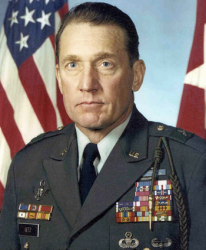
Charles Edward Getz |
||||
|
Graduate, U.S. Military Academy, Class of 1959 Engagements: • Vietnam War (1960 - 1973) |
||||
| Biography: | ||||
|
Charles Edward Getz Charles Edward Getz was born on 1 August 1936, the youngest of four children. Growing up in Massachusetts, he went to preparatory schools, one of them a naval honors school near Cape Cod. He became the first student from that school to receive an appointment to the U.S. Military Academy, where he reported on 5 July 1955 with the Class of 1959. At West Point, Getz was an outstanding athlete in several sports and he earned All-American honors in Lacrosse. The Class of 1959 graduated on 3 June 1959 and Getz was commissioned as a Second Lieutenant of Infantry in the U.S. Army. He then attended the Infantry Officer Basic Course, Airborne School, and Ranger School at Fort Benning, GA. On 8 October 1966, then-Captain Getz was serving as Commanding Officer of Company B, 2nd Battalion (Airborne), 8th Cavalry Regiment, 1st Cavalry Division (Airmobile), in South Vietnam. On that day, CPT Getz' unit was conducting search and clear operations along the coast of the South China Sea, RVN. After receiving information that about 20 Viet Cong were hiding in caves on a small island, CPT Getz organized a pair of 2-man teams armed with bayonets to dive into the hazardous waters. CPT Getz personally led the men in locating the underwater cave entrances. His leadership by diving into the water, locating one of the caves, and bringing a Viet Cong to the surface, inspired 2 other men to also seek out enemy soldiers. Diving repeatedly into the rough seas, the swimmers brought 2 Viet Cong to the surface. In one cave, CPT Getz engaged 4 Viet Cong and killed one of them in hand-to-hand combat. Despite the strong undertow and coral-covered rocks, CPT Getz and the other swimmers repeatedly dived into the water, bringing up a total of 17 Viet Cong with supplies, food, and arms. On the last dive, one of the men was swept out to sea and CPT Getz went to his rescue. With the assistance of another swimmer, he pulled the man to safety. His courageous actions earned him the U.S. Army's third highest award for valor, the Silver Star Medal. On 13 September 1966, CPT Getz was on an air assault mission near Bong Son, RVN. As CPT Getz' Company B was moving down the side of a mountain, the lead platoon spotted a village occupied by about 40 North Vietnamese Army regulars. CPT Getz placed his company in the best possible position for an attack, then moved to the front of the unit to gain better control and observation of the company during the sweep. Just as the company was about to attack, the enemy began firing with automatic weapons from a nearby bunker. Seeing that the rest of the group was pinned down, CPT Getz personally charged the bunker, firing his rifle until the position was silenced. Noticing that several paths of escape lay in all directions from the village, CPT Getz then ordered one platoon to drive through the village while another element covered the escape routes. With CPT Getz leading by personal example, the village was overrun and secured. He was awarded a Bronze Oak Leaf Cluster for his Silver Star Medal. [Although the action date of 13 September 1966 obviously came before the action date 8 October 1966, the General Orders for the October action was approved two months and two days before approval of the September action.] During 27 to 28 February 1967, CPT Getz' Company B was on a combat air assault mission near Bong Son, RVN. After making a reconnaissance of the area, CPT Getz positioned his platoon leaders while receiving heavy sniper fire from a small village. Noticing several cane fields to the front of his positions that blocked the fields of fire, CPT Getz rushed forward and began burning them way. The North Vietnamese soldiers in the village observed his action and took him under fire, but he remained in the open area until he had set the entire field ablaze. That night, while keeping close watch on his under-strength positions as they received sporadic sniper fire, CPT Getz moved forward under increasing fire to recover a mortally-wounded soldier. Early the next morning, an artillery preparation was fired prior to launching an attack on the village. When one man was wounded, CPT Getz ran forward and helped pull the soldier to a safe area. The company then began its attack on the village, but met heavy resistance that almost halted the assault. CPT Getz rushed to the front of the assault element and began charging the enemy. Inspired by their commander's courageous act, CPT Getz' men charged and swept through the village, sustaining a minimum number of casualties. CPT Getz' extraordinary heroism earned him a 2nd Bronze Oak Leaf Cluster for his Silver Star Medal. [No citation is available for the award of the Third Bronze Oak Leaf Cluster] After Getz was promoted to Major he was sent back to the U.S. and assigned as Commander, Florida Ranger Camp, 3rd Training Battalion. He remained there for two years, and went back to school before being deployed to Vietnam again. On 12 November 1970, now-Major Getz, was Battalion Commander of 1st Battalion, 52nd Infantry Regiment, 23rd Infantry Division, RVN. An element of the Battalion was conducting a night raid on the Village of Cay Thi about 10 miles west of the village of My Lai. MAJ Getz led one of the elements into the village and encountered intense fire from the North Vietnamese and Viet Cong soldiers hiding in different positions. He charged through the intense hostile fire and silenced one Viet Cong soldier thato had been shooting from the concealment of a tree. On another occasion, MAJ Getz exposed himself to fire while running to the aid of a wounded comrade and, upon reaching him, he placed fire on those enemy that had been responsible for wounding the American soldier. After silencing this position, he exposed himself to North Vietnamese sniper fire while assisting in evacuation of the wounded man. This action in the village resulted in the elimination of a significant number of the enemy. While moving back to their night defensive position, his element was fired on by an unknown-size hostile force. Grabbing a machinegun, he led an element across an open field and silenced the remaining enemy force. Through his timely and courageous actions, he contributed greatly to the success of the operation and was instrumental in inflicting numerous casualties upon the enemy. Major Getz' personal heroism earned him a 4th Bronze Oak Leaf Cluster for his Silver Star Medal. On 19 October 1970, MAJ Getz was serving with Headquarters and Headquarters Company, 1st Battalion, 52nd Infantry Regiment, 198th Infantry Brigade, 23rd Infantry Division, while commanding a combat air assault operation near Thach An Dong, Son Tinh. Prior to troop insertion, MAJ Getz was reconnoitering the area in his control helicopter when an enemy force was observed near a small hamlet. While flying at low altitude in order to mark the first landing zone for the delivery of his troops, his helicopter began receiving enemy ground fire. Ignoring the heavy volume of fire concentrated on his aircraft, MAJ Getz directed his pilot to the second landing zone, marking it with smoke grenades. Moments later, his helicopter landed so that he could personally direct the ground movements of his two platoons against the opposing force. To coordinate the advance of both platoons, MAJ Getz raced 200 meters across an open rice paddy although enemy fire was directed almost entirely at him. Advancing to an enemy emplacement, MAJ Getz eliminated the position and its 3 occupants. As he continued forward, he discovered an enemy tunnel. He entered the tunnel and captured a North Vietnamese soldier and his weapons. Still exposed to hostile fire, he maneuvered his two platoons in a successful assault against the well-fortified enemy emplacements. During the entire engagement, MAJ Getz's aggressive, determined efforts boosted the morale of his troops and inspired them to maintain the offensive and defeat the enemy force. Major Getz's extraordinary heroism earned him the U.S. Army's second highest award for valor, the Distinguished Service Cross. On 9 February 1971, MAJ Getz was serving as Battalion Commander, 1st Battalion, 52nd Infantry Regiment, 23rd Infantry Division. On that date, while on a reconnaissance flight over a heavily vegetated area, MAJ Getz spotted several North Vietnamese Army Regulars on a trail. He had the helicopter land immediately so that he could pursue the enemy. He ran after the insurgents, wounding one of them in the leg and arm. He then moved back to the aircraft and instructed the pilot to move to where the wounded enemy soldier was and pick him up. MAJ Getz then moved back to the wounded insurgent and waited for the helicopter. When the aircraft arrived it came under intense small arms fire from an unknown-size enemy force. MAJ Getz moved to the helicopter through the open area with the wounded insurgent. Due to his timely and courageous actions, several important documents were captured, along with the enemy soldier, who was identified as a North Vietnamese Army Officer. Major Getz' courageous actions and personal heroism earned him a 5th Bronze Oak Leaf Cluster for his Silver Star Medal. On 8 May 1971, MAJ Getz was awarded the Soldier's Medal, the U.S. Army's highest medal for heroism at the risk of life not involving conflict with an armed enemy. Throughout his long Army career, Charles Getz had myriad assignments in locations around the world and involving command and staff positions. In his final two assignments before retirement he served as Chief of the Joint U.S. Military Assistance Group in the Philippines from June 1982 to August 1984, followed by serving as Assistant Commander of the 2nd Infantry Division in South Korea from August 1984 until his retirement in August 1987. While he was Assistant Commander of the 2nd Infantry Division, his military career was substantially altered. He was severely injured in a training accident when he fell off a cliff during a night attack with one of the battalions he was testing. He was lucky to survive and was sent back to the U.S. to the Walter Reed Army Medical Center with a punctured kidney. As a result of the injury, the Army said he could never again command troops, and he didn't want to stay in the Army to be a staff officer. However, fate intervened about a month before Getz was to retire. After Getz recovered from the accident, the Army offered him an opportunity to go to the Central Intelligence Agency (CIA) to be a National Intelligence Officer. The Army had one position with the Agency because of the paramilitary operations' training of other armies, but he turned down the job because it was essentially a staff officer position and he wasn't interested. But the Director of Operations of the CIA called Getz just prior to the finalization of his retirement from the Army and asked for a meeting. Getz agreed to the meeting and he was offered a position with the CIA as a military retiree. Getz immediately saw the benefits to that position. The CIA could use him in areas where they could not under normal circumstances - they could send him places. In addition, the CIA doesn't really have a lot of constraints and rules that normal government agencies have. At that time, if you went to work for the government, you lost your military retirement pay; you just had the government salary. But, the Agency had this deal that would allow Getz to keep his Army retirement pay. He accepted the job. Service with the Central Intelligence Agency (CIA) He saw lots of very interesting places in the world, serving in Africa, Latin America, Afghanistan, Pakistan, Iraq and Kuwait. Getz was one of the first non-military personnel to enter Kuwait City during the first Gulf War. He served in Iraq until he left the Agency in 1993. Medals, Awards, Badges & Tabs Distinguished Service Cross * Korean Defense Service Medal: Although this medal did not exist until 2 December 2002, it is retroactive to the end of the Korean War and is granted to any service performed after 28 July 1954. The National Personnel Records Center is responsible for verifying entitlement of the KDSM to discharged members of the military who served in Korea prior to the creation of the KDSM. Therefore, BG Getz is entitled to the medal for his service from August 1984-87. Distinguished Service Cross Citation The President of the United States of America, authorized by Act of Congress, July 9, 1918 (amended by act of July 25, 1963), takes pleasure in presenting the Distinguished Service Cross to Major (Infantry) Charles Edward Getz (ASN: 0-87133), United States Army, for extraordinary heroism in connection with military operations involving conflict with an armed hostile force in the Republic of Vietnam, while serving with Headquarters and Headquarters Company, 1st Battalion, 52d Infantry, 198th Infantry Brigade, 23d Infantry Division. Major Getz distinguished himself by exceptionally valorous actions on 19 October 1970 while commanding a combat air assault operation near Thach An Dong, Son Tinh. Prior to troop insertion, Major Getz was reconnoitering the area in his control helicopter when an enemy force was observed near a small hamlet. While flying at low altitude in order to mark the first landing zone for the delivery of his troops, his helicopter began receiving enemy ground fire. Ignoring the heavy volume of fire concentrated at his aircraft, Major Getz directed his pilot to the second landing zone, marking it with smoke grenades. Moments later, his helicopter landed so that he could personally direct the ground movements of his two platoons against the opposing force. To coordinate the advance of both platoons, Major Getz raced two-hundred meters across an open rice paddy although enemy fire was directed almost entirely at him. Advancing to an enemy emplacement through a barrage of fire, Major Getz eliminated the position and its three occupants. As he continued forward, he discovered an enemy tunnel. He unhesitatingly entered the tunnel and captured a North Vietnamese soldier and his weapons. Continuously exposed to hostile fire, he effectively maneuvered his two platoons in a successful assault against the well-fortified enemy emplacements. Throughout the entire engagement, Major Getz's aggressive and determined efforts boosted the morale of his troops, inspired them to maintain the offensive, and defeat the hostile enemy force. Major Getz's extraordinary heroism and devotion to duty were in keeping with the highest traditions of the military service and reflect great credit upon himself, his unit, and the United States Army. General Orders: Headquarters, U.S. Army, Vietnam, General Orders No. 1567 (May 8, 1971) Honors ● Inducted into the U.S. Army Rangers Hall of Fame |
||||
| Honoree ID: 310971 | Created by: MHOH | |||
Ribbons
Medals
Badges
Honoree Photos
|  | |
| |
|