


 |
|
|
||
|
Henry Everett Emerson 'Gunfighter' |
||||
|
Graduate, U.S. Military Academy, Class of 1947 Engagements: • Korean War (1950 - 1953)• Vietnam War (1960 - 1973) |
||||
| Biography: | ||||
|
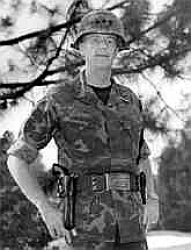
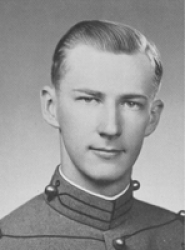
Henry Everett Emerson Henry Everett Emerson was born on 28 May 1925 at Walter Reed Army Hospital in Washington, DC, where his father, an Army doctor, was on the medical staff. He attended Lowell High School in San Francisco, CA, where he joined ROTC and became the cadet battalion commander for Lowell. ROTC had a system where they formed all high schools into two regiments. There were ten high schools and Emerson was a regimental commander, a cadet full colonel. He received a Congressional appointment to the U. S. Military Academy in 1944 where during his Plebe year, in his own words, he became a "very indifferent cadet." Fortunately, a mentor, Colonel Lester Wheeler, came along and changed his attitude right before graduation. He graduated from the Academy in 1947 and was commissioned as a Second Lieutenant of Infantry.During his Army career, Emerson has served overseas in Korea, Japan, Hawaii, London, Dominican Republic and Vietnam. His initial assignment was as Executive Officer, Company L, 31st Infantry, 7th Division then stationed in Korea. He went to Hawaii in 1949 and returned to the 7th Division in Korea in 1950. He was Aide-de-Camp to General Mark Clark in the Far East Command Headquarters, Japan, in 1952-53. Emerson served on the staff of the U. S. Army Element, Naval Elements Atlantic and Mediterranean, London, England in 1961-62. For four months in 1965 he was Special Assistant to the Commanding General, XVIII Airborne Corps, Headquarters U.S. Forces, Dominican Republic. He then served in Vietnam for a year, first as Operations Officer, Task Force Alpha, then as Battalion Commander, 2d Battalion, 502d Infantry, 1st Brigade, 101st Airborne Division. In January 1968 he returned to Vietnam as Commander, 1st Brigade, 9th Infantry Division, until he was wounded in August and returned to the U.S. Included in his stateside assignments are: Instructor, The Infantry School, Fort Benning, GA, 1951-52; Department of Tactics, USMA, West Point, NY, 1954-58; Operations Officer and Executive Officer, 1st Airborne Battle Group, 502d Infantry, 101st Airborne Division, Fort Campbell, KY, 1959-60; and Chief, Schools and Education Division, Office, Deputy Chief of Staff for Personnel, Department of the Army, 1966-68. Military schools attended include The Infantry School, the Naval War College, Armed Forces Staff College and Army War College. During the Vietnam War, Colonel Emerson gained recognition for his tactical ability and the tactics he used on the battlefield., which were novel. The aerial reconnaissance and combat methods that he conceived and employed were very effective against the Viet Cong. His tactics included a checkerboard concept that involved small groups covering grid squares to seek out an enemy, and jitterbug tactics which were complex maneuvers using helicopters to surround the enemy. [To the uninitiated, the maneuvers would seem 'jittery' like the dance.] He also had 'Eagle Flights' that consisted of helicopters loaded with local soldiers that, in certain situations, were rapidly flown in to assist foreign troops. These unique tactics demonstrated that U.S. soldiers could effectively "out-guerrilla" the Viet Cong. Emerson also developed the "seal and pile-on technique," which was the rapid build-up of combat power to surround and destroy an enemy force. These highly complex tactics shattered many large enemy units. Emerson was known for his somewhat eccentric personality, from his training methods to carrying a cowboy-style revolver in place of a regulation M1911 semi-automatic pistol. He was a believer in reverse-cycle training, during which troops trained at night and slept during the day. He also required that they watch the television film, Brian's Song, to promote racial harmony. Colin Powell, who would later go on to become Chairman of the Joint Chiefs of Staff, and the U.S. Secretary of State, has stated that he and Emerson were very close and that what set Emerson apart was his great love for his soldiers and concern for their welfare. Emerson suffered severe burns when his helicopter was shot down in the Mekong Delta. From May 1973 to May 1975, Major General Emerson commanded the 2nd Infantry Division in South Korea. When LTG Emerson was Commander of the XVIII Airborne Corps at Fort Bragg, NC, from July 1975 to June 1977, in some instances, he would turn in the tag numbers of excessively speeding vehicles. The next morning, the violator(s) would be escorted from their unit by their company and battalion commanders and a verbal reprimand would be delivered by the brigade commander. [Not the behavior of the average Lieutenant General commanding an Army Corps.] LTG Emerson retired from the Army on 30 June 1977. Medals and Awards Distinguished Service Cross with Bronze Oak Leaf Cluster Distinguished Service Cross Citation (1st Award) The President of the United States of America, authorized by Act of Congress, July 9, 1918 (amended by act of July 25, 1963), takes pleasure in presenting the Distinguished Service Cross to Colonel (Infantry) Henry Everett Emerson (ASN: 0-50868), United States Army, for extraordinary heroism in connection with military operations involving conflict with an armed hostile force in the Republic of Vietnam, while serving as Commanding Officer of the 1st Brigade, 9th Infantry Division. Colonel Emerson distinguished himself by exceptionally valorous actions on 5 April 1968 as commander of an infantry brigade during a reconnaissance-in-force mission in Dinh Tuong Province. One of his brigade elements came under intense automatic weapons fire when it enter an unmarked mine field. Because of the fire, its advance was halted and the momentum of its attack was imperiled. Upon hearing of this, Colonel Emerson directed his command aircraft to land in the battle area where, completely disregarding his own safety, he took command of the beleaguered element. His presence on the battle field under intense fire quickly inspired his men to redouble their efforts and gain fire superiority over the enemy. After assuring that the insurgents were well under control, he returned to his helicopter and was informed that another battalion was engaging a large insurgent force and was having trouble in determining the exact deployment of the enemy. He directed his craft to fly over the battle area to assess the situation. His ship was flying at a low level, and it was immediately subjected to fierce enemy fire. Using the muzzle flashes to detect the location of the Viet Cong, he ordered his battalion into a position where it could encircle the insurgents and begin their methodical destruction. Observing five Viet Cong fleeing the conflict area, he directed his pilot to land. He immediately leaped from the aircraft, and, using only his pistol, killed one of the enemy and captured another. General Orders: Headquarters, U.S. Army, Vietnam, General Orders No. 3361 (July 15, 1968) Distinguished Service Cross Citation (2nd Award) The President of the United States of America, authorized by Act of Congress, July 9, 1918 (amended by act of July 25, 1963), takes pleasure in presenting a Bronze Oak Leaf Cluster in lieu of a Second Award of the Distinguished Service Cross to Colonel (Infantry) Henry Everett Emerson (ASN: 0-50868), United States Army, for extraordinary heroism in connection with military operations involving conflict with an armed hostile force in the Republic of Vietnam, while serving as Commanding Officer of the 1st Brigade, 9th Infantry Division. Colonel Emerson distinguished himself by exceptionally valorous actions from 30 May to 4 June 1968 in the Plain of Reeds while leading his brigade against the Viet Cong. Two days of ground sweeps failed to uncover the communists. Colonel Emerson boarded his helicopter on 1 June and directed that he be taken on a low-level reconnaissance through the operation area. He located a Viet Cong base camp and ordered an air assault against it. Ignoring heavy anti-aircraft fire which was directed at and struck his ship, he circled above the battle area at less than three hundred feet and called air strikes on the enemy. Frequently he landed to personally direct the maneuver of his troops. As evening came a severe thunderstorm lashed the battle site, but he stayed in the air until he was told that his craft was flying on emergency fuel. During the night the enemy units fled, and although Colonel Emerson located their escape route the next day, they disappeared before his troops could re-engage them. Flying at tree-top level on 3 June, he discovered a massive Viet Cong bunker complex and immediately committed his forces in a series of air assaults. His men came under devastating automatic weapons fire, and by late afternoon the situation was critical. By landing at strategic points in the midst of the enemy fusillade and repeatedly flying low over the communists' positions, Colonel Emerson was able to skillfully coordinate his troops' maneuvers and direct air and artillery bombardments on the hostile emplacements. As he conducted a bitter night assault which completely encircled the Viet Cong, his helicopter was hit six times by enemy machine gun fire and disabled. After landing to obtain another ship and a fresh crew he returned to the fight, staying with his men until long after midnight to insure that the wounded were evacuated, all units were resupplied and arrangements were made for continued air and artillery strikes. The struggle ended the next morning and two first line Viet Cong battalions had been shattered. General Emerson's heroism and devotion to duty are in keeping with the highest traditions of the military service and reflect great credit on him and on the U.S. Army. General Orders: Headquarters, U.S. Army, Vietnam, General Orders No. 5021 (October 29, 1968) Silver Star Medal The President of the United States of America, authorized by Act of Congress July 9, 1918, takes pleasure in presenting the Silver Star to Captain (Infantry), [then First Lieutenant] Henry Everett Emerson (ASN: 0-50868), United States Army, for gallantry in action against the enemy while serving with Company A, 5th Infantry Regiment, 25th Infantry Division, in action in the vicinity of Sobuk-san, Korea, from 23 August to 11 September 1950. When his company commander and all other officers in the company had been killed during an attack near Sobuk Mountain, Captain Emerson assumed command, reorganized the company and coolly reported the situation to the battalion commander. When ordered to continue the attack, he led the depleted unit up the rugged slopes of the towering mountain and secured his objective. After repelling several vicious counterattacks, the company exhausted their ammunition, but Captain Emerson refused to give up his position until he reported the facts and received permission to withdraw. By his forceful leadership and tactical skill, he succeeded breaking contact with the enemy and withdrew to a more secure position. The following day Captain Emerson renewed the attack and seized his objective, which he organized and secured under heavy enemy fire. Thereafter and until 11 September, the enemy made twenty-seven savage, slashing, determined efforts to retake the position but without success. On four of these days Captain Emerson was the only officer present in the company, his platoon leaders being wounded faster than they could be replaced. However, by his determination and personal example of daring and heroism, in laying wire and mine fields, resupplying ammunition and deploying his steadily dwindling force and their weapons, he so inspired his men that never once did they yield ground to the enemy. He constantly exposed himself to enemy machine-gun, small-arms, mortar, artillery and grenade fire. Several times he was knocked down by the force of explosions from enemy mortars or artillery, but he never lost control of his unit and moved from position to position frequently encouraging his men and directing their fire. His aggressive leadership was a deciding factor in holding the vital position. The gallantry displayed by Captain Emerson reflects great credit upon himself and the military service. Action Date: August 23 - September 11, 1950 Death and Burial Lieutenant General Henry Everett Emerson died on 4 February 2015. He is buried at the Arlington National Cemetery in Arlington, Arlington County, VA. http://www.findagrave.com/cgi-bin/fg.cgi?page=gr&GRid=142306500 |
||||
| Origin of Nickname/Handle: | ||||
|
The nickname came from the cowboy-style six-shooter revolver he wore, instead of the regulation M1911 semi-automatic pistol. See the photo section. |
||||
| Honoree ID: 306747 | Created by: MHOH | |||
Ribbons
Medals
Badges
Honoree Photos
|  |  |
 | |
|