


 |
|
|
||
|
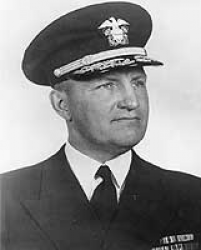
Don Pardee Moon |
||||
|
Engagements: • World War I (1914 - 1918)• World War II (1941 - 1945) |
||||
| Biography: | ||||
|
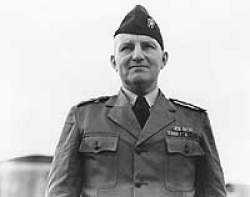
Don Pardee Moon was born in Kokomo, IN, on 18 April 1894. Moon received an appointment to attend the U.S. Naval Academy where he was a swimmer and wrestler. He also demonstrated special proficiency in ordnance and gunnery, fields that would occupy much of his subsequent Navy career. Following his graduation (fourth in his class) and commissioning as an Ensign in June 1916, Moon was assigned to the battleship USS Arizona (BB-39) and remained with her for over four years. During this time he devised a number of instruments to facilitate ships' gunnery. In 1921-22 Lieutenant Moon attended the Postgraduate School at Annapolis, MD, and the University of Chicago, which then had ordnance assignments ashore. He served in the battleships USS Colorado (BB-45) and USS Nevada (BB-36) from mid-1923 until mid-1926 and spent most of the rest of the decade at the Bureau of Ordnance and the Naval Gun Factory, both located in Washington, DC. Lieutenant Commander Moon was a destroyer squadron Gunnery Officer with the U.S. Fleet from 1929-32, followed by instruction and staff duty at the Naval War College. In 1934, he became Commanding Officer of the Asiatic Fleet destroyer USS John D. Ford DD-228). In 1936, Moon was promoted to the rank of Commander and, during 1937, he commanded a destroyer division. Following that command, he returned to the Naval War College to attend the senior course and serve on the War College staff. In 1940 he was again placed in command of a destroyer division and, after attaining the rank of Captain in September 1941, moved up to command an Atlantic Fleet destroyer squadron. During the wartime year of 1942, Captain Moon's squadron participated in efforts to move convoys through the dangerous waters north of Norway and took part in the invasion of North Africa. From November 1942 to January 1944, Captain Moon served on the staff of the Chief of Naval Operations, Admiral Ernest J. King. At the end of this tour he was promoted to Rear Admiral and placed in command of an amphibious task group. During the June 1944 invasion of Normandy, he directed the landings on Utah Beach from USS Bayfield (APA-33). For three weeks the Bayfield was in position off Utah beach and her officers and men were on four-hour rotating shifts for the entire time. Following the conclusion of that operation, Rear Admiral Moon and the Bayfield was sent to the Mediterranean and Naples to perform the same function during the forthcoming invasion of Southern France. However, apparently suffering from mental exhaustion brought on by his intense efforts to ensure the success of two very demanding amphibious operations, Rear Admiral Don P. Moon shot himself with his .45 caliber pistol on 5 August 1944. Time Magazine, Monday, 21 August 1944 An impeccable Navy career had come to a tragic end. Rear Admiral Don Pardee Moon, commander of a task force in the invasion of Normandy, had taken his own life. The Navy, announcing his death last week, did not say how or where, offered no explanation except "battle fatigue." Handsome, 50-year-old Don Moon, fourth in his class (1916) at the Naval Academy, served on a battleship in World War I, made his way quietly up the naval ladder between wars. In 1942, as commander of a destroyer squadron, he helped support the landings on North Africa and was officially cited for "exemplary conduct" and "leadership under fire." For Admiral Moon, as far many another officer, the invasion of Normandy was the high point of a career. He played his part with precision and assurance. Happily married and the father of four children, Don Moon was well-liked, a successful Navy man. What happened in his war-weary mind no outsider could guess. Though war has always had its combat suicides, Army and Navy annals record no precedent among officers of comparable rank. Medals and Awards Army Distinguished Service Medal Citations Army Distinguished Service Medal: The President of the United States of America, authorized by Act of Congress July 9, 1918, takes pride in presenting the Army Distinguished Service Medal (Posthumously) to Rear Admiral Don Pardee Moon, United States Navy, for exceptionally meritorious and distinguished services to the Government of the United States, in a duty of great responsibility as the Commander of Assault Force "U" in the amphibious invasion of the coast of Normandy, France, commencing on 6 June 1944. Rear Admiral Moon operated his forces during the assault period of the invasion against enemy opposition, and successfully landed the VII Corps, United States Army, on the selected beaches in the Madeleine area. General Orders: War Department, General Orders No. 68 (1944) Action Date: 6-Jun-44 Legion of Merit: The President of the United States of America takes pride in presenting the Legion of Merit (Posthumously) to Rear Admiral Don Pardee Moon, United States Navy, for exceptionally meritorious conduct in the performance of outstanding services to the Government of the United States as a Naval Task Force Commander prior to the amphibious invasion of Southern France in August 1944. Rear Admiral Moon exerted himself most conscientiously and with extreme energy throughout the extended planning phase in preparation for the execution of assault landings on the Coast of Southern France. Devoting meticulous attention to all details of his complex task, he developed sound, workable, and complete plans for the maintaining and execution of an assault in divisional scale over selected beaches which, from intelligence sources, were known to be strongly defended by artillery and machine gun emplacements, mines, and underwater obstacles. Owing to his unfortunate and untimely death, he was deprived of the opportunity of leading his forces into action against the enemy. The extraordinary ability, sound judgment, and outstanding devotion to duty displayed by Rear Admiral Moon reflected great credit upon himself and the United States Naval Service. General Orders: Commander 8th Fleet: Serial 5013 (September 10, 1944) Action Date: Aug-44 Family Don Moon was survived by his wife Sibyl Peaslee Hall Moon and his four children, Meredith, Don, David, and Peter. Burial Rear Admiral Don Pardee Moon is buried at Arlington National Cemetery. http://www.findagrave.com/cgi-bin/fg.cgi?page=gr&GRid=59529313 Footnote from the Compiler of this Biography As the August 1944 article from Time Magazine says, Army and Navy annals record no precedent of combat suicide among officers of rank comparable to Rear Admiral Moon. This obviously leads to the question: Why did this accomplished warrior take his own life? My dear Moon: Rear Admiral Don Pardee Moon is a book by Author Jonathan P. Alter, with Editor Daniel Crouch, published in September 2005. The 'teaser' to this book reads as follows: "Rear Admiral Moon's death was officially ruled a suicide; but the testimony at the Board of Inquiry raises questions about what really happened - which Jonathan P Alter and Daniel Crouch present to the reader more than sixty years later in 'My dear Moon.' Drawing from extensive research, including e-mail interviews of veterans, primary source documents from the Moon family, old historical newspapers and Government documents - some obtained via Freedom of Information Act requests, Alter and Crouch unearth the mystery of the cause of this great man's death." For those of you who want to know more, the book is available from Amazon.com. |
||||
| Honoree ID: 211635 | Created by: MHOH | |||
Ribbons
Medals
Badges
Honoree Photos
|  |  |
| |
|