


 |
|
|
||
|
Edward Cragg 'Porky' |
||||
|
Engagements: • World War II (1941 - 1945) |
||||
| Biography: | ||||
|
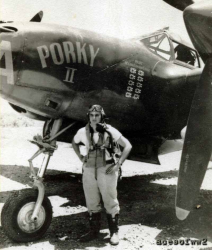
Edward Cragg Edward Cragg grew up in the Greenwich / Cos Cob area of Connecticut. He graduated from Greenwich High School in the class of 1936 and, in September 1937, enrolled in the School of Commerce, Accounts and Finance at New York University to pursue a BS degree in Accounting. In September 1940, Cragg withdrew from the university and, on 30 November, enlisted as an Aviation Cadet in the U.S. Army Air Corps. Cragg received his elementary training at Albany, GA, and his basic training at Gunter Field, AL, between February and April 1941. His advanced training took place at the Air Corps Advanced Flying School at Craig Field in Selma, AL. On 11 July 1941, he was commissioned as a Second Lieutenant in U.S. Army Air Corps Reserve, with the rating of Pilot. Cragg was ordered to active duty the next day. 2LT Cragg's first operational duty assignment was as Assistant Squadron Engineering Officer in the Panama Canal Zone. He was later named Engineering Officer of the 28th Pursuit Squadron, 37th Pursuit Group, stationed at Albrook Field in the PCZ. In the spring of 1942, he was reassigned to the 80th Pursuit Squadron, 8th Pursuit Group, Fifth Air Force, in the Southwest Pacific theater. On 5 September 1942, he was promoted to First Lieutenant. His units were soon redesignated from Pursuit to Fighter becoming the 80th Fighter Squadron, 8th Fighter Group. Initially, the squadron flew Bell P-39 Airacobras. 1LT Cragg named his plane "Porky" and that soon became his nickname. On 17 December 1942, Cragg was promoted to the rank of Captain and the 80th Squadron received its new Lockheed P-38 Lightning fighter planes that month; Cragg named his Porky II and made his last 9 kills in that aircraft. Captain Cragg became commander of the 80th Fighter Squadron on 8 April 1943 and quickly named the squadron The Headhunters in tribute to the local New Guinean headhunter tribes that hated the Japanese and helped rescue downed pilots. He even commissioned a former Walt Disney Studios artist, crew chief Yale Saffro, to design the 80th Squadron's patch with the likeness of the proud Papuan Chief of New Guinea. Cragg was promoted to Major on 6 July 1943 and, on 21 August, his 80th Squadron was in aerial combat against Japanese aircraft in the Southwest Pacific Theater of Operations. MAJ Cragg's flying skills and courageous actions that day earned him the U.S. Army's second highest award for valor, the Distinguished Service Cross. On 26 December 1943, 17 P-38 Lightnings of the 80th Fighter Squadron was flying cover on the Allied landing at Cape Gloucester, New Britain. The mission was to patrol the friendly convoy and beachhead in the vicinity of Borgen Bay and engage intercepting aircraft. Major Cragg was Flight Leader. The Japanese interceptors, consisting of 25-30 Val-type dive-bombers [The Aichi D3A Type 99 Carrier Bomber] and 50-60 fighters, was first sighted about 4 miles west of Borgen Bay at 1445 hours. They were observed at the 10 o'clock position with their top flights about 5,000 feet about the 80th Squadron aircraft. The P-38 Lightnings were at 10,000-15,000 feet, stacked up to 19,000 feet. The Japanese dive-bombers were at 10,000 feet, flying in bunches rather than in any definite formation. They were escorted by fighters on each side stacked up to 24,000 feet in flights of 4. The P-38s climbed for altitude to attack and harass the enemy fighters and to keep them at a high altitude, thus giving the P-47s, P-40s, and other P-38s from the squadron protection in hitting the dive-bombers. Although every effort was made to keep flights intact, the large number of enemy planes encountered and the ensuing mix-up forced many of our planes to break away and execute individual attacks. MAJ Cragg took his flight down to the level of the dive-bombers while the rest of the formation remained at altitude to engage the fighters. LT Ladd, flying on MAJ Cragg's wing, reported that his leader flew right into a mess of Vals. He then became separated from the flight and was not seen again until LT Adams saw him shoot down a Tojo-type fighter, after which he headed for the clouds with a Japanese fighter on his tail and his plane was smoking. LT Adams made a head-on pass at the fighter that was after MAJ Cragg and shot it down. He then saw MAJ Cragg's plane fall out of the clouds. The plane was burning and LT Adams remained in the area to look for a parachute; it did not appear and LT Adams returned to base. It was later reported that several Marines on the ground saw a parachute from a P-38 descend behind Japanese lines. Since MAJ C. E. Taylor was the only other P-38 pilot to bail out, and since he landed in the water (he was picked up by the Navy), it is assumed that the parachute observed by the Marines was MAJ Cragg's. Although Army Liason planes and Navy PBYs conducted search patrols in the area, nothing was found and he was listed as Missing in Action. On 16 January 1946, MAJ Cragg's status was changed from Missing in Action to Killed in Action, Body Not Recovered. The loss of MAJ Cragg was sharply felt by the 80th Squadron. Under his leadership the Headhunters had knocked down over 160 enemy planes in less than 9 months. His endless energy and eagerness was mainly responsible for the achievement of that record. The plane he destroyed on 26 December was his 15th officially credited victory. Fellow squadron member and Ace, Major Jay Cock Robbins, succeeded Cragg as commander of the Headhunters. While Cragg was flying with the 80th Fighter Squadron he compiled an air-to-air combat record of 15 confirmed kills and 2 probables, earning him the title Triple Ace. Medals, Awards and Badges Distinguished Service Cross Distinguished Service Cross Citation For extraordinary heroism in action near Wewak, New Guinea, on 21 August 1943. Major Cragg, commanding his fighter squadron, escorted a bomber formation attacking an Airdrome. About twenty enemy interceptors were encountered. With all his squadron engaged, he observed ten additional enemy fighters about to deliver a coordinated attack on our bombers. With great daring, he throttled back and, using his plane as a decoy, diverted their concentrated attack upon himself. This action enabled our bombers to make an accurate and successful run unmolested. He then acted as sole fighter escort for the bombers on the return journey, shooting down one enemy plane and damaging another en route. In deliberately engaging ten enemy fighters single-handed, Major Cragg acted with conspicuous gallantry, and contributed greatly to the success of the mission. Headquarters: U.S. Army Forces in the Far East, General Orders No. 54 (1943) Congressional Gold Medal The Congressional Gold Medal, created by the U.S. Mint, is the highest civilian honor Congress can give on behalf of the American people. On 20 May 2015, leaders from the U.S. House of Representatives and Senate presented the Congressional Gold Medal to the American Fighter Aces Association at the U.S. Capitol Visitor Center Emancipation Hall. More than 60,000 American fighter pilots engaged in aerial combat during World War I, World War II, the Korean War and the Vietnam War. Of those pilots, only 1,447 earned the title of fighter “Ace” by downing at least five enemy aircraft. Major Edward Cragg was one of them, having been credited with 15 aircraft shot down in aerial combat, earning him the title Triple Ace. At the time of the presentation of the Medal, only 75 of those Aces remained alive. Memorialization The remains of Major Edward Cragg were never recovered. He is memorialized with his name inscribed on the Tablets of the Missing at the Manila American Cemetery and Memorial in Manila, Metro Manila, National Capital Region, Philippines. Major Cragg is also memorialized with a cenotaph at the Arlington National Cemetery in Arlington, Arlington County, VA, in Section MK, Site 203. |
||||
| Honoree ID: 131585 | Created by: MHOH | |||
Ribbons
Medals
Badges
Honoree Photos
|  | |
| |
 |