


 |
|
|
||
|
JOHN MELVILLE BLUNDELL |
||||
|
Engagements: • World War II (1941 - 1945) |
||||
| Biography: | ||||
|
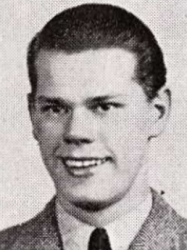
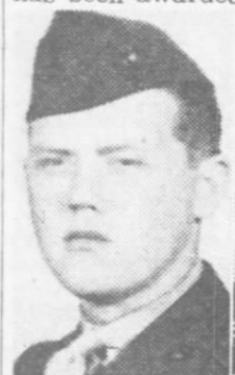
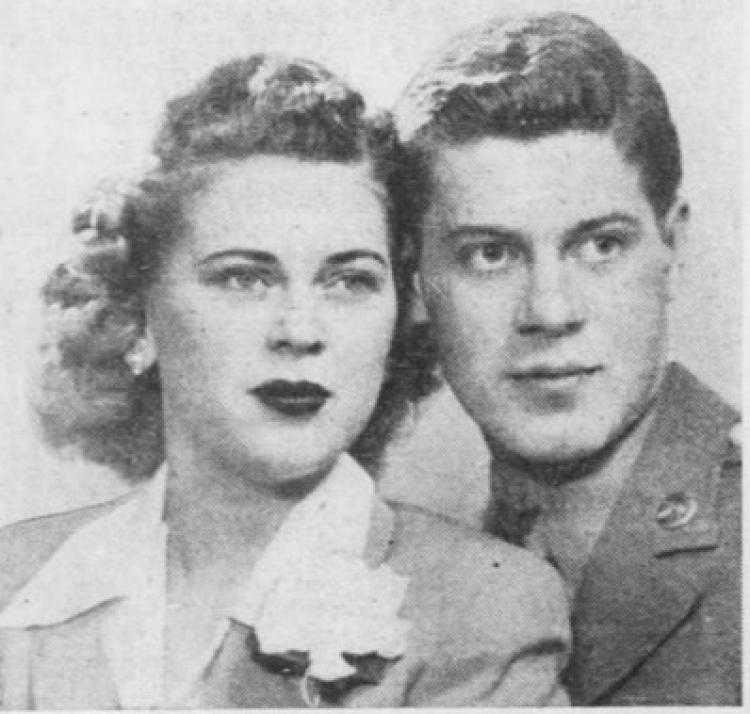
John Melville Blundell Aviation Radioman Third Class, United States Navy Distinguished Flying Cross JOHN MELVILLE BLUNDELL was the son of Melville George Blundell and Eleanor H. Blankart, both of Detroit, MI., who married on 12 Jan 1920 in Detroit. His siblings, both born in Detroit, were Robert William Blundell and Shirley M. Blundell Schueler. She m. on 16 April 1943 James Lewis Schueler. Melville and Eleanor divorced on 6 April 1928, and Eleanor married for the second time on 2 Mar 1929 in Detroit, Thomas W. McKinney. The family moved to Fort Wayne, IN in early 1940. Melville, a WWI veteran, died in Washington state on 21 Dec 1936. After enduring the violent loss of her two sons in WWII, and later the death of her daughter in 1963 at the age of 38, Eleanor McKinney died in Fort Wayne, IN on 2 Jan 1985. Her remains were cremated. John attended Detroit's Southeastern high school graduating in June 1940. He was Captain in the R.O.T.C. unit, Cheerleader, and track club to name a few. While in high school John worked at the Detroit Free Press circulation department. To assist the family financial situation John enlisted for four years in the Volunteer US Naval Reserve (NSN: 410-41-61), USNR, V-1, as an Apprentice Seaman (A.S.) on 25 July 1938 in Detroit. He was assigned to the Naval Reserve unit 9th Division, 3rd Battalion, Detroit. He was then transferred home to inactive status. Several days later, he was transferred from class V-1 to 0-1 and from the 9th Div to the medical unit, 17th Battalion, USMCR. On 31 July, he reported for 15 days of Active Duty Training (ACDUTRA) at Camp Ben Fuller, Naval Training Station (NTS), Great Lakes, IL. On 14 Aug, he was released from ACDUTRA and returned home. He began weekly drilling. The following year on 10 Feb 1939, Blundell transferred back to Class V-1 status and from the 17th Battalion to the 9th Division, USNR where he was in training as a Hospital Corpsman. On 08 Aug 1940, Blundell applied for enlistment to the US Navy at the Naval Recruiting Station, Ft. Wayne, IN. He passed his physical, completed an aptitude test and supplied references during the enlistment process. The same month Blundell requested a discharge from the USNR so that he might enlisted in the US Navy. He was discharged from the Naval Reserve on 23 Sep 1940. After obtaining his mother’s permission, Blundell enlisted on 25 Sep 1940 in the US Navy at the US Navy Recruiting Station, Indianapolis, IN for six years with a rank of A.S. He immediately took five days leave before reporting for active duty on 01 Oct 1940 at the Naval Training Station (NTS), Great Lakes, IL for recruit training. After he completed recruit training, he detached from NTS Great Lakes, IL and transferred to the aircraft carrier USS Enterprise (CV-6) on 28 Oct 1940. Several days later on 02 Dec 1940, Blundell reported for duty to Torpedo Squadron Six (VT-6) attached to the Enterprise. He was advanced in rate to Seaman Second Class (S2c) on 25 Jan 1941. The following month he qualified as a marksman and sharpshooter on 28 Feb. On 01 April 1941, he received orders to duty participating in regular and frequent aerial flights in aircraft. In June, he changed his rate to Radioman Striker. He was advanced in rate to Seaman First Class (S1c) on 01 Jul 1941. He would remain a Radioman Striker until 01 Jan 1942 when he was advanced in rate to Radioman Third Class (RM3). RM3 Blundell changed his rate to Aviation Radioman Third Class (ARM3) on 01 Mar 1942. The Enterprise was commissioned on 12 May 1938. During 1939, Enterprise and her embarked squadrons conducted shake down cruises and workup exercises at various times. While the ship was inport the squadrons were temporarily based ashore at their assigned airfields. In Sep 1939 Enterprise became part of the Hawaiian Detachment of the U.S. Fleet whose homeport was Pearl Harbor. In Jan 1940 Enterprise was engaged in exercises in Hawaiian waters. In early Feb she steamed for Puget Sound Navy Shipyard for an overhaul after making a brief port call in San Diego. In late May, Enterprise, her overhaul completed, returned to San Diego for about a month. She returned to Pearl Harbor on 2 July 1940. Enterprise conducted exercises from August to early Nov in the Hawaiian area. Then on 09 Nov she steamed to San Diego until 2 Dec when she set sail for the Puget Sound Navy Shipyard in Bremerton, WA. She returned to Pearl Harbor on 21 Jan 1941. During 1941 Enterprise made 13 round trips between Hawaii and San Diego from April - Nov conducting exercise cycles and squadron work-ups. During those months she also shuttled Army Air Force P-39s and P-40s, as well as, Navy aircraft from US West Coast ports to Pearl Harbor and beyond. On 28 Nov 1941, Enterprise, now operating in a war-time steaming condition, left San Diego with a cargo of Marine Fighting Squadron 211 (VMF-211) aircraft and pilots destined for Wake Island. The Marine pilots and their planes flew from Enterprise to Wake Island on 02 Dec 1941. Enterprise was scheduled to arrive back in Pearl Harbor on 06 Dec, but was delayed due to inclement weather. Fortunately, she wasn't inport on the morning of 07 Dec, but arrived later that evening. In the first five months of 1942, Enterprise and her Air Group participated in the Gilbert and Marshall Islands and Wake Island operations in Feb 1942. According to a Report After Battle narrative submitted by VT-6 on 2 Feb 1942, Ltjg Eversole, flying aircraft 6-T-11 with his gunner/radioman, RM3 Blundell, launched from the Enterprise at 0731 on 01 Feb 1942. This second division, led by the squadron executive officer, Lcdr Lance Massey, comprised nine torpedo armed aircraft that were to attack enemy Japanese shipping, in and around Kwajalein Atoll. The division was credited with a number of torpedo hits on shipping including hits on a light cruiser. After returning to Enterprise, the nine VT-6 first division aircraft led by Lcdr Eugene Lindsey, loaded with bombs, launched again about 0935 to attack the air field and surface ships at Wotje Island and Atoll. During all attacks VT-6 bombers and torpedo armed planes were met with intense anti-aircraft fire from numerous locations. Both divisions returned with no casualties. About 3 weeks later, VT-6 participated in the Wake Island raid 24 Feb 1942. On 4 March, Enterprise’s Air Group attacked enemy installations on the Marcus Islands; and on 18 April, she supported the Doolittle raid. In early May, Enterprise and the aircraft carrier USS Hornet (CV-8) were dispatched to the South Pacific to assist the aircraft carriers USS Lexington (CV-2) and USS Yorktown (CV-5) who were engaged in the battle of the Coral Sea. However, before the ships arrived on-scene the battle of the Coral Sea was over. After participating in additional operations in the Central Pacific, Enterprise returned to Pearl Harbor on 26 May and began intensive preparations to meet an expected Japanese thrust at Midway Island. On 28 May, Enterprise and Hornet sortied from Pearl Harbor and steamed toward Midway and "Point Luck." USS Yorktown (CV-5) followed a short time later. Early on the morning of 4 Jun 1942, pilot, Ensign John Wiley Brock, and his radioman-gunner ARM3 John M. Blundell launched their torpedo plane from Enterprise along with other aircraft of VT-6 and Air Wing Six to attack the Japanese Striking Force that was near Midway. Separated from their covering fighter protection, VT-6 comprised of 14 torpedo planes pressed their attack even though overwhelmed by superior numbers of Japanese fighter aircraft. One by one the planes of VT-6 were shot down. Of the 14 planes only 4 returned to Enterprise. Ens Brock and Petty Officer Blundell did not return. According to the Enterprise after action report for the Battle of Midway dated 8 Jun 1942 Ens. Brock and radioman/gunner RM3 Blundell were reported as personnel losses during battle. They were officially considered missing-in-action 04 Jun 1942 and presumed dead on 5 Jun 1943. Their remains were unrecoverable. On 18 Jun 1942, the Navy Dept. sent a telegram to Mrs Eleanor H. McKinney, Blundell’s mother, stating that it deeply regrets to inform her that her son was missing following action in the performance of his duty. Of the 14 Torpedo Bombers from VT-6 that attacked the Japanese Striking Force on 4 Jan 1942 only four returned to Enterprise. Machinist Albert Walter Winchell (NAP), and his gunner, Aviation Radioman 3rd Class Douglas M. Cossitt, made a water landing before sighting Enterprise. They survived 17 days on the open seas in a rubber raft before being rescued by a Patrol Squadron 24 PBY on 21 Jun 1942, some 360 miles northward of Midway. In all, five VT-6 crews survived the morning attack. ----------------------------------- ARM3 Blundell was awarded (posthumously) the Distinguished Flying Cross, Purple Heart, Presidential Unit Citation and ribbon, American Defense Service Medal, Asiatic-Pacific Campaign Medal with a bronze star and the World War Two Victory Medal. ---------------------------------------- The pilots and aircrew of VT-6 that killed in action on 04 June 1942 were: 1) Lcdr Eugene Elbert Lindsey (CO VT-6) and his gunner, ARMC Charles Tilden Grenat 2) Lt Arthur Vincent Ely (VT-6 XO) and his gunner, RM3 Arthur Richard Lindgren 3) Lt Paul James Riley and his gunner, ARM2 Edwin John Mushinski 4) Ltjg John Thomas Eversole and his gunner, RM2 John Udell Lane 5) Ensign Severin Louis Rombach and his gunner, ARM2 Wilburn Forrest Glenn 6) Ltjg Lloyd Thomas and his gunner, ARM2 Harold Francis Littlefield 7) Ensign Randolph Mitchell Holder and his gunner, ARM3 Gregory Joseph Durawa 8) Ensign John Wiley Brock and his gunner, ARM3 John Melville Blundell 9) Ensign Flourenoy Glenn Hodges and his gunner, RM2 John Hail Bates ---------------------------------- The Distinguished Flying Cross Citation reads: The President of the United States of America takes pleasure in presenting the Distinguished Flying Cross to John M. Blundell, aviation radioman second class United States Navy, for services set forth in the following citation: For extraordinary achievement and heroic conduct in aerial flight as free gunner and radio operator of an airplane in Torpedo Squadron Six in action against enemy Japanese forces in the Battle of Midway, 4 to 6 June 1942. Blundell’s unflinching devotion to duty and his courageous determination in returning the fire of enemy Japanese fighters enabled his pilot to press home an attack against concentrated anti-aircraft fire and violent fighter opposition. His marked integrity in maintaining continuous fire in the face of such tremendous odds and his complete disregard for his personal safety were in keeping with the highest traditions of the United States Naval Service. Citation transcribed from copy of original in his service record. Text is the same -- format is different. ----------------------------------- The Presidential Unit Citation reads: For consistently outstanding performance and distinguished achievement during repeated action against enemy Japanese forces in the Pacific war area, 7 December 1941, to 15 November 1942. Participating in nearly every major carrier engagement in the first year of the war, the Enterprise and her air group, exclusive of far-flung destruction of hostile shore installations throughout the battle area, did sink or damage on her own a total of 35 Japanese vessels and shot down a total of 185 Japanese aircraft. Her aggressive spirit and superb combat efficiency are fitting tribute to the officers and men who so gallantly established her as an ahead bulwark in the defense of the American nation. Actions of the Enterprise mentioned in the citation include the Gilbert and Marshalls of 01 Feb 1942; Wake Island raid, 24 Feb 1942; Marcus Island raid, 04 Mar 1942; Battle of Midway, 4-6 Jun 1942; Occupation of Guadalcanal, 7-8 Aug 1942; Battle of Stewart Islands, 24 Aug 1942; Battle of Santa Cruz Islands, 26 Oct 1942; and Battle of Solomon Islands, 14-15 Nov 1942. -------------------------------- The Honor Scroll commemoration sent to his family reads: In grateful memory of John Melville Blundell, who died in the service of his country, SEA, Pacific Area, ATTACHED U.S.S. ENTERPRISE, 5 JUNE 1943 (Presumed). He stands in the unbroken line of patriots who have dared to die that freedom might live and grow and increase its blessings. Freedom lives, and through it, he lives – in a way that humbles the undertakings of most men. (Signed) Franklin D. Roosevelt,President of the United States ----------------------------------------- Task Force 16 Citation Recognizing its contribution to the Doolittle Raid, 18 April 1942 On the occasion of the 50th anniversary of the Second World War, it is appropriate that we take time to reflect on the unique and daring accomplishments achieved early in the war by Task Force 16. Sailing westward under sealed orders in April 1942, only four months after the devastating raid on Pearl Harbor, Task Force 16, carrying sixteen Army B-25 bombers, proceeded into history. Facing adverse weather and under constant threat of discovery before bombers could be launched to strike the Japanese homeland, the crews of the ships and LTC Doolittle's bombers persevered. On 18 April 1942 at 14:45, perseverance produced success as radio broadcasts from Japan confirmed the success of the raids. These raids were an enormous boost to the morale of the American people in those early and dark days of the war and a harbinger of the future for the Japanese High Command that had so foolishly awakened "The Sleeping Giant." These exploits, which so inspired the service men and women and the nation live on today and are remembered when the necessity of success against all odds is required. (Signed) John H.Dalton Secretary of the Navy 15 May 1995 ------------------------------------------- The Indianapolis News (Indianapolis, IN) - 20 Jun 1942, Sat – p.23 Ft. Wayne Sailor Missing. Ft. Wayne, IN - June 20 (spl)-- Mrs Thomas W. McKinney, living near Ft. Wayne, has been informed by the navy department that her son, John Blundell, age twenty-one, is missing in action in the Pacific. He enlisted in 1940, was at Pearl Harbor and participated in a naval engagement in February. -------------------------------------------- Garrett Clipper (Garrett, Indiana) – 4 Mar 1943, Thu – p. 2 col 2 Another war-time honor was bestowed on a Fort Wayne hero when the Distinguished Flying Cross was awarded John Melville Blundell, age 22, for his performance of duty under fire. Blundell has been reported by the navy department as “missing in action” in the Pacific area since June 19, 1942, but his mother Sunday night said: “I’m not giving up hope; he may be held prisoner.” Prior to his last known engagement, Blundell, an aviation radio man, third class, in the U.S. Navy, had participated in two other engagements. These were the Jap bombing of Pearl Harbor which precipitated the United States into the war and in February of 1942 in the southwest Pacific area. He enlisted in the navy in June of 1940 shortly after the family moved to Fort Wayne from Detroit. Last word Mrs. McKinney has received from her son was in a letter last June. --------------------------------------------- The Indianapolis Star (Indianapolis, Indiana) – 6 Mar 1943, Sat – p. 22. 2 Missing Hoosiers Given Flying Crosses Two Indiana navy men, both listed as missing in action, have been awarded the Distinguished Flying Cross for heroic action in the battle of Midway. The Hoosiers are John Hail Bates, radioman second class, 23 years old, of Hebron, and John Melville Blundell, aviation radioman third class, son of Mrs. Eleanor McKinney of Fort Wayne. Bates is a nephew of Roger H. Bates of Valparaiso, his next of kin. Their citations states: “For extraordinary heroism and heroic conduct in aerial flight as free gunner and radio operator of an airplane in a Torpedo squadron in action against Japanese forces in the battle of Midway June 4-6, 1942.” ------------------------------------------- Detroit Free Press (Detroit, MI) - 14 Mar 1943, Sun – p. 9 John M. Blundell, a 1940 graduate of Southeastern High School, has been awarded the Distinguished Flying Cross for performance of duty under fire in the Pacific. The award was sent to this mother, Mrs. Thomas W. McKinney, of Fort Wayne, IN, since Blundell has been reported by the Navy Department as "missing in action" since last 19 Jun. His mother clings to the hope that he may have been taken prisoner. A radioman, third class, Blundell enlisted in the Navy a few days after his graduation from high school. He has a brother, Robert, who has arrived safely at an overseas destination with a Marine Corps unit, according to word received by his mother. Their sister, Shirley, lives at Alden Park Manor, and their grandmother, Mrs. V. G. Bond, lives at 2917 Bewick. -------------------------------------------------- Combat Action Ribbon (CR) note (2019 version): None of the Navy/Marine flight crews in the Battle of Midway were eligible for or were awarded the Combat Action Ribbon (CR). See Navy and Marine Corps Awards Manual (SECNAVINST M-1650.1 of 16 Aug 2019, Appendix 2C.1.c (3) Amplifying Guidance). It reads in part, “The CR will not be awarded in connection with aerial flight, . . . “ The CR was established in 1969 and made retroactive to 07 Dec 1941. ------------------------------------------- Bio#130 compiled on 16 Oct 2017 by Gerry Lawton Military Hall of Honor ID:88450 Find a Grave Memorial ID: 56115713 John's brother, Robert Blundell's Military Hall of Honor ID:318457 |
||||
| Honoree ID: 88450 | Created by: MHOH | |||
Ribbons
Medals
Badges
Honoree Photos
|  |  |
 |  |
 |