


 |
|
|
||
|
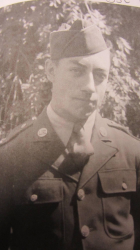
Roger E. Côté |
||||
|
Engagements: • World War II (1941 - 1945) |
||||
| Biography: | ||||
|
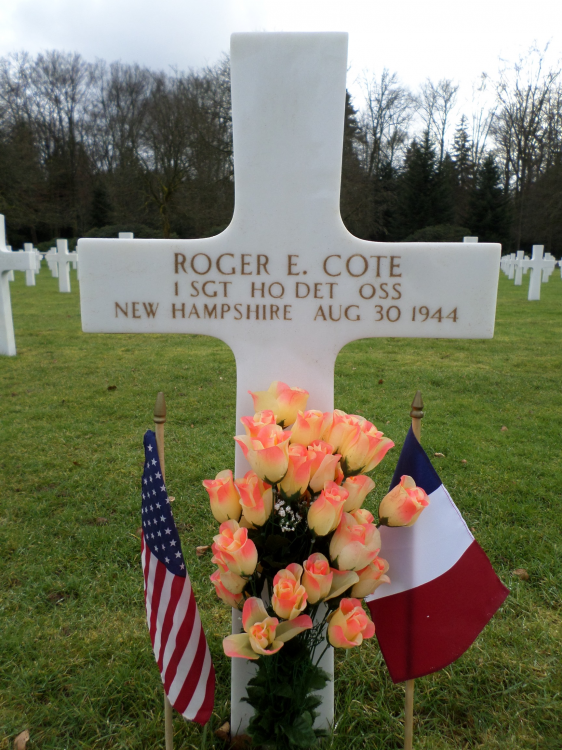
Roger E. Côté Roger E. Côté entered the U.S. Army on 9 November 1942, in Manchester, NH. In August 1944, First Sergeant Roger E. Côté, a radio operator, was serving as one of three members of Jedburgh Team (Jeds) em>Augustus, Headquarters, Office of Strategic Services, in the European Theater of Operations. The commander of Team Augustus was Major John Halsey Bonsall {Honoree Record ID 67981] and the 3rd member was Captain Jean Delviche of the French Army. Delviche was a professional officer born in Vivaise, a small village 10 kilometers north of Laon. He was a profoundly quiet man, probably due to the death of his wife and child to illness. The following data is excerpted from a paper written by S. J. Lewis for the U.S. Army Command and General Staff College, Fort Leavenworth, Kansas 66027-6900. The entire document can be read at http://usacac.army.mil/cac2/cgsc/carl/download/csipubs/lewis.pdf. The data below is contained in document pages numbered 26-29. Team Augustus, 15 August 1944 SFHQ dispatched Augustus as the 34th Jedburgh team to the Continent on 15 August 1944 to the Aisne region, where it was to assist the local Maquis and serve as an additional communication link to London. On the night of 15 August, Team Augustus flew from England with 24 containers weighing 3 tons and with no other passengers. Landing near the hamlet of Colonfay, about 15 kilometers south of Guise, they moved to Le Nouvion-en-Thierache, the local resistance headquarters. On the afternoon of 16 August, they reached a farm near the village of Clary, which the resistance suggested would be much safer. The team radioed SFHQ on 17 August that the reception had gone perfectly. Two days later, they reported that they had successfully contacted the local resistance leader. At that meeting, they apparently decided to follow the suggestion of the resistance to conduct operations to the south near Soissons. On 20 August, the team radioed that the resistance movement in the Aisne Department was quite advanced, with 1,100 men armed and trained and 4,900 unarmed men. On 21 August, the team moved south about 100 kilometers to the village of Rugny. Through 24 August, the team sent London several reports on specific targets for the Allied air forces, mostly large German troop columns headed east for the German border or trains stuck between railroad demolitions. On the 25th, however, Augustus reported that there were so many German troops in the area that it would be unwise to form any Maquis (French Resistance) and that hiding places were becoming harder to find. The following day, the team reported that the Germans were constructing field fortifications behind the Aisne River, although without minefields. On 28 August, they learned that American tanks were in the vicinity and moved north to Soissons. There, they briefed staff officers of the U.S. 3rd Armored Division on German defenses in the area. The American officers displayed particular interest in the German camp at Margival. SFHQ, on 30 August, sent Augustus the following message: Have received order from Army commander for FFI to take all possible steps to preserve following Somme bridges from enemy demolition. All bridges Amiens area, also at Moreuil, Boves, Fiquigny, Conde, Longpre. You should attempt to preserve these bridges for about four days after receipt this message. This is important task. Count on you for fullest cooperation. If you need arms can drop from low flying Typhoons. Team Augustus presumably received this message. That same day, the team passed through the American lines north of Laon (south of Froidmont), an area well known to Captain Delviche. A subsequent OSS investigation revealed that all 3 members were shot and killed on the night of 30 August at the village of Barenton-sur-Serre. Apparently, German troops stopped a horse-drawn cart (borrowed from a French farmer, Mr. Magnien) and found the 3 occupants in civilian clothes, carrying false French identity cards, and equipped with weapons, a radio, and other equipment. Since the German troops were the remnants of an armored unit interested mainly in escaping to the German border, they undertook no further searches but merely shot the team and soon departed in the rain. The horse, still towing its cart, returned on its own to its stable in Mr. Magnien's barn, which was occupied by armed FFI volunteers. The return of the horse and empty cart created considerable consternation. Mr. Magnien and his colleagues found the bodies of Jedburgh Team Augustus the following morning, buried the 3 men at the Bareriton-sur-Serre cemetery, and subsequently erected a memorial in their honor. Later that day, the U.S. 3rd Armored Division swept through the area in pursuit of the retreating German forces. 1SG Cote's courageous actions and extraordinary heroism during that mission earned him the U.S. Army's second highest award for valor, the Distinguished Service Cross. Medals, Awards and Badges Distinguished Service Cross Distinguished Service Cross Citation (Synopsis) First Sergeant Roger E. Cote (ASN: 11084219), United States Army, was awarded the Distinguished Service Cross (Posthumously) for extraordinary heroism in connection with military operations against an armed enemy while serving with Headquarters, Office of Strategic Services, in action against enemy forces from 15 through 30 August 1944, in France. First Sergeant Cote's intrepid actions, personal bravery and zealous devotion to duty at the cost of his life, exemplify the highest traditions of the military forces of the United States and reflect great credit upon himself, his unit, and the United States Army. General Orders: Headquarters, European Theater of Operations, U.S. Army, General Orders No. 61 (1945) Burial First Sergeant Roger E. Côté is buried at the Epinal American Cemetery and Memorial in Epinal, Departement des Vosges, Lorraine, France in Plot A, Row 17, Grave 41. |
||||
| Honoree ID: 68514 | Created by: MHOH | |||
Ribbons
Medals
Badges
Honoree Photos
|  | |
| |
 |